Rectangular Duct Expansion Joints: Design, Selection & Installation Guide | DEVEL
[Henan, China] — In large-scale industrial ducting systems, rectangular ducts are everywhere — from boiler economizer outlets to electrostatic precipitator inlets, from gas turbine exhaust to cement kiln preheater ducts. Yet these ducts expand, contract, and shift with every temperature change. Without a properly engineered rectangular duct expansion joint, that movement transfers directly into the ductwork, causing buckling, flange leakage, and catastrophic structural failure. Henan Devel Fluid (DEVEL) provides this technical guide to help engineers and procurement teams specify, select, and install rectangular expansion joints with confidence.
───────────────────────────────────────
WHAT IS A RECTANGULAR DUCT EXPANSION JOINT?
A rectangular duct expansion joint is a flexible connector installed between two sections of rectangular or square ducting to absorb thermal expansion, vibration, and structural movement. Unlike circular pipe expansion joints (which deal with circumferential hoop stress), rectangular expansion joints must handle longitudinal beam bending stresses — making their design fundamentally different.
These joints are used in low-pressure, high-temperature gas ducting applications where duct sizes are too large or too irregular for standard circular expansion joints. Since no two ducts are exactly the same, every rectangular expansion joint is custom-engineered to match the specific dimensions, temperature, pressure, and movement requirements of the installation.
───────────────────────────────────────
KEY DESIGN CONSIDERATIONS
- Corner Configurations
The corner design is the most critical structural element of a rectangular expansion joint. DEVEL offers three primary corner types:
Single Miter Corner — Two flat plates meet at the corner with a single weld at the apex. This is the simplest and most economical option, suitable for moderate movement and temperature.
Double Miter Corner — A formed corner section with welds positioned at least 24 inches from the corner apex. By eliminating welds at the point of maximum stress, double miter corners extend service life significantly — making them the preferred choice for high-cycle or high-temperature applications.
Camera (Rounded) Corner — A curved corner section that distributes stress more evenly. Available in limited sizes, this configuration offers superior fatigue resistance for demanding service conditions.
- Convolution Profiles
The flexible bellows element is available in several convolution shapes:
- V-shape (accordion) — the most common profile, offering excellent flexibility and compact dimensions
- U-shape — provides higher movement capacity per convolution
- Omega (round) — optimized for pressure resistance in larger joints
Single or multiple convolutions can be specified depending on the total movement requirement.
- Material Selection
Material choice directly determines corrosion resistance, temperature capability, and service life:
- 300 Series Stainless Steels (SS304, SS316L, SS321) — the standard choice for most flue gas and process duct applications
- Corten (ASTM A588) — cost-effective for moderate-temperature flue gas service with good atmospheric corrosion resistance
- High-Nickel Alloys (Inconel 625, Incoloy 800, Hastelloy X) — specified for extreme temperature or highly corrosive gas streams
- Carbon Steel — typically used for frame components and external hardware only
───────────────────────────────────────
MOVEMENT CAPACITY
Like circular expansion joints, rectangular expansion joints absorb three types of movement:
- Axial: Compression or extension along the duct centerline, caused by thermal expansion and contraction
- Lateral: Offset movement parallel to the duct face — critical to identify whether movement is parallel to the long or short side of the bellows
- Angular: Rotational deflection around the duct center point
For rectangular designs, it is essential to specify the direction of lateral and angular movements relative to the long and short sides of the joint, as this directly affects the bellows stress calculation.
───────────────────────────────────────
FABRIC VS. METAL RECTANGULAR EXPANSION JOINTS
Rectangular duct expansion joints are available in two primary constructions:
Metal Rectangular Expansion Joints
- Formed metal bellows (V or U profile) with mitered or rounded corners
- Higher pressure capability, suitable for pressurized duct systems
- Temperature range up to 1800°F (982°C) with appropriate alloys
- Designed per EJMA 10th Edition
- Ideal for: refinery process ducts, steam systems, high-temperature exhaust
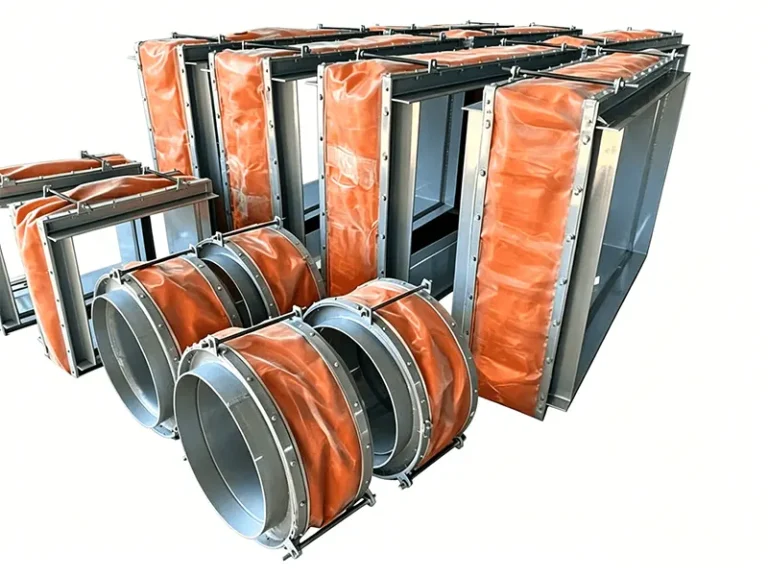
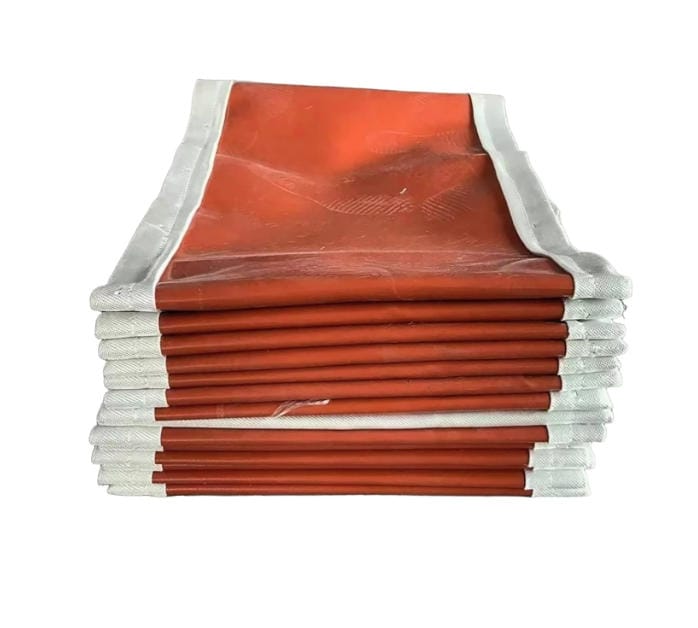
Fabric Rectangular Expansion Joints
- Multi-layer composite construction with PTFE barrier membrane and ceramic fiber insulation
- Near-zero reaction force — no heavy restraint frameworks required
- Temperature range up to 1000°C (1832°F)
- FGD/SCR compliant — total impermeability to acid condensates
- Lightweight (<10% of equivalent metal bellows weight) for easy installation
- Ideal for: flue gas desulfurization, boiler outlet ducts, gas turbine exhaust, cement kilns
DEVEL engineers both types — contact our team to determine which is optimal for your application.
───────────────────────────────────────
INSTALLATION BEST PRACTICES
- Alignment First — Ducting must be aligned within 1/8″ (3 mm) before installing the joint. The expansion joint is not designed to compensate for piping misalignment errors.
- Proper Anchoring — Install expansion joints as close as possible to anchor points. Where duct direction changes, proper anchoring is mandatory. If anchoring is insufficient, control rods must be used to prevent excessive elongation.
- Duct Support — The expansion joint must never carry duct loads. Independent supports on both sides of the joint are required.
- Bolt Tightening Sequence — Tighten bolts in stages, alternating around the flange (star pattern). For fabric joints with retaining rings, ensure washers are used against the ring split to prevent leakage. Torque values vary by joint size — follow DEVEL’s installation manual for your specific model.
- No Welding Nearby — Do not weld in the vicinity of an installed expansion joint. Weld spatter and radiant heat can damage both fabric and metal bellows elements.
- Post-Installation Check — Re-check bolt tightness 2–3 days after installation and periodically thereafter. Thermal cycling can cause gasket relaxation.
───────────────────────────────────────
TYPICAL APPLICATIONS
- Power plant boiler economizer outlet to chimney ducts
- Flue gas desulfurization (FGD) inlet and outlet ducts
- Gas turbine exhaust systems and heat recovery ducts
- Cement kiln preheater and cooler ducts
- Steel mill dust extraction and hot blast ducts
- Refinery process gas ducting
- Precipitator and SCR system connections
───────────────────────────────────────
WHY CHOOSE DEVEL FOR RECTANGULAR DUCT EXPANSION JOINTS?
Henan Devel Fluid Equipment Co., Ltd. is a factory-direct manufacturer with over a decade of experience in custom-engineered rectangular expansion joints. Every joint is built to your exact duct dimensions — not adapted from standard sizes.
- Both fabric and metal constructions available
- All corner types: single miter, double miter, camera/rounded
- Full material range: 300 series stainless steels, Corten, Inconel, Hastelloy
- EJMA-compliant design with full engineering calculations
- Optional flow liners, external shrouds, and control rod systems
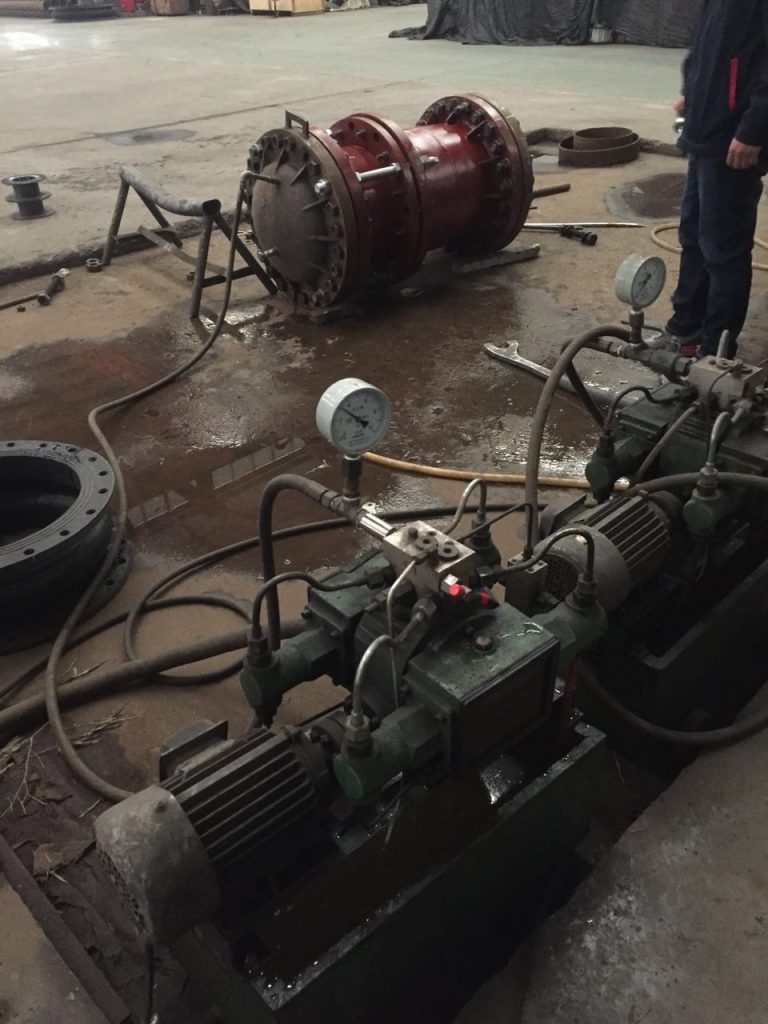
- In-house pressure testing and dimensional QC before shipment
- Custom quotes within 48 hours
───────────────────────────────────────
FREQUENTLY ASKED QUESTIONS
What is the difference between single miter and double miter corners?
A single miter corner has one weld at the apex where two flat plates meet. A double miter corner uses a formed section with welds positioned away from the apex — at least 24 inches from the corner. Double miter corners reduce stress concentration at the most vulnerable point, extending fatigue life. They are recommended for high-temperature or high-cycle applications.
Can rectangular expansion joints handle pressure?
Metal rectangular expansion joints can handle moderate internal pressures, typically designed for low-pressure duct systems (under 5 PSIG). Fabric rectangular expansion joints are designed for near-atmospheric pressures (±0.35 bar). For higher-pressure applications, circular expansion joints are generally more appropriate — contact DEVEL for guidance.
How do I specify the correct movement direction?
For rectangular joints, lateral and angular movements must be specified relative to the long and short sides of the bellows. A movement of 50 mm parallel to the long side creates a different stress profile than 50 mm parallel to the short side. Provide a sketch or drawing showing the movement direction with your inquiry.
Do you offer internal flow liners?
Yes. For applications with high-velocity gas or abrasive particulate content, DEVEL offers internal flow liners (baffles) in high-alloy steel foil. The liner is directional — a flow arrow on the frame indicates correct installation orientation.
───────────────────────────────────────
GET A CUSTOMIZED RECTANGULAR DUCT EXPANSION JOINT QUOTATION
Every rectangular duct is unique — and so is every expansion joint that fits it. Send DEVEL your duct dimensions, operating temperature, pressure, movement requirements, and gas composition. Our engineering team will return a custom-designed solution with a quotation within 48 hours.
Email: info@develfluid.com
Website: https://develfluid.com/contact-us/
Phone: +86 18137171953
Henan Devel Fluid Equipment Co., Ltd. — Your Partner in Industrial Ducting Solutions.