How to Source High-Quality Rubber Expansion Joints: Procurement Guide | DEVEL
[Henan, China] — In the world of industrial fluid transport, the cost of a poor-quality rubber expansion joint is rarely found on the invoice — it’s found in the field. Cracking beads, weeping bolts, deformed bellows, and collapsed suction joints: these failures typically occur within months of commissioning, costing far more in downtime than was ever saved on the purchase price.
While high-quality rubber expansion joints represent a slightly higher upfront investment, they provide something procurement teams value even more: predictable performance and the documentation to prove it. This guide from Henan Devel Fluid (DEVEL) is designed to help purchasing and engineering teams issue RFQs and POs with total confidence.
───────────────────────────────────────
WHAT ARE YOU REALLY BUYING?
A rubber expansion joint is more than just a flexible connector — it is a risk-mitigation tool for your entire piping system. When sourcing rubber expansion joints, you are evaluating four primary risks:
- Material Compatibility Risk: The elastomer and reinforcement must withstand both the media and the operating temperature. A generic “rubber” specification is not enough.
- Pressure & Vacuum Risk: Pressure ratings change with size and temperature. Incorrect specifications lead to catastrophic bursts or collapses under vacuum.
- Movement Risk: Joints must accommodate axial, lateral, and angular movement without being forced to “fix” poor piping alignment.
- Installation Risk: Most premature failures result from incorrect installation, missing control rods, or over-tightening — not from material defects.
───────────────────────────────────────
5 CRITICAL QUESTIONS TO ASK BEFORE ISSUING AN RFQ
- Is the Elastomer Compatible with Your Media?
Don’t just specify “water.” Be precise about chemicals, oils, abrasives, and UV/ozone exposure (for outdoor installations). Always require specific tube and cover material callouts:
- EPDM — excellent for water, steam, and mild chemicals; poor oil resistance
- NBR (Nitrile) — superior oil and fuel resistance; limited ozone resistance
- Neoprene (CR) — good all-around balance of oil, weather, and flame resistance
- Butyl — excellent gas permeation resistance; used in chemical and gas applications
Tip: If a supplier cannot confirm the specific elastomer grade, that is a red flag.
- What Are the Pressure and Temperature Limits?
Rubber’s ability to hold pressure drops as temperature increases. A joint rated for PN16 at 20°C may only be safe at PN10 at 80°C. Always confirm the derated pressure-temperature curve for your operating conditions.
DEVEL’s rubber expansion joints cover PN6 through PN25 (Class 150/300 equivalent), with standard temperature ranges from -15°C to +115°C continuous (special compounds available for extended ranges).
- What Movements Are Required?
Ensure your engineering team provides expected values for all three movement types:
- Axial: Compression or extension along the pipe centerline (mm)
- Lateral: Offset movement perpendicular to the centerline (mm)
- Angular: Bending deflection around the center point (degrees)
Ask whether control rods are required to prevent over-extension. Control rods are not designed to absorb pressure thrust — they limit joint movement to protect the bellows from over-travel.
- Is There Vacuum Service?
Negative pressure on pump suctions can collapse a standard joint that was designed for positive pressure only. Specify your vacuum requirements explicitly. DEVEL’s standard joints handle vacuum up to 650 mm Hg; for deeper vacuum, internal vacuum support rings or a modified bellows design may be required.
- Does the Flange Standard Match?
Confirm the drilling standard and flange material before placing the order:
- Flange Standards: ANSI/ASME B16.5 (Class 150/300), EN 1092 (DIN), JIS B2220, GB/T 9119
- Flange Materials: Carbon steel (general service), SS304 (corrosion-resistant), SS316/S316L (chemical and marine)
Mismatched flange drilling is one of the most common — and most avoidable — installation problems on site.
───────────────────────────────────────
REQUIRED DOCUMENTATION PACKAGE
To prevent “cheap” substitutions from slipping through, make these deliverables a mandatory requirement in your RFQ:
- Submittal Drawings & BOM
Detailed dimensions including face-to-face length, flange thickness, bellows profile, and specific material callouts for tube, cover, and reinforcement. - Pressure Test Reports
Evidence of a repeatable QA process. High-quality joints should offer a burst safety margin of at least 300% of rated working pressure. DEVEL hydrostatically tests every joint before shipment. - Installation Instructions
Proper torque settings, bolt sequence, and alignment guidelines. Many “material failures” are actually installation errors that proper documentation could have prevented.
───────────────────────────────────────
RFQ CHECKLIST (COPY AND USE)
Use this checklist when preparing your RFQ or inquiry email:
Category: Service Conditions
Requirement: Media / Temperature / Design Pressure / Vacuum
Category: Connections
Requirement: Size (DN/NPS) / Flange Standard / Face-to-Face __
Category: Movements
Requirement: Axial / Lateral / Angular __ / Control Rods Needed? (Y/N)
Category: Materials
Requirement: Tube Elastomer / Cover Elastomer / Flange Material __
Category: Submittals
Requirement: Drawings Required? (Y/N) / BOM Included? (Y/N) / Pressure Test Report? (Y/N)
───────────────────────────────────────
COMMON PROCUREMENT MISTAKES
Mistake 1: Specifying only “rubber expansion joint” with no material callout
Problem: You receive whatever the supplier has in stock — often the cheapest generic compound.
Fix: Always specify the exact elastomer (EPDM, NBR, Neoprene) for both tube and cover.
Mistake 2: Ignoring the derated pressure at operating temperature
Problem: A joint rated PN16 at ambient may fail at PN10 at 80°C.
Fix: Request the pressure-temperature derating curve and specify your maximum operating temperature.
Mistake 3: Omitting control rods on joints subject to vacuum or thrust
Problem: The joint over-extends or collapses, causing catastrophic failure.
Fix: Include control rods in the specification whenever vacuum, thrust, or significant movement is present.
Mistake 4: Accepting joints without pressure test certificates
Problem: No proof of quality — you discover defects only after installation.
Fix: Require hydrostatic test reports with every shipment. No exceptions.
Mistake 5: Matching flange drilling by “eye” instead of standard
Problem: Bolt holes don’t align on site, causing costly delays.
Fix: Confirm the flange standard (ANSI/DIN/JIS/GB) and verify before ordering.
───────────────────────────────────────
WHY CHOOSE DEVEL FOR RUBBER EXPANSION JOINTS?
At Henan Devel Fluid, we provide engineered solutions — not just catalog items.
- Custom Engineering: Tailored products for high pressure, large diameters, unique media, and special flange standards
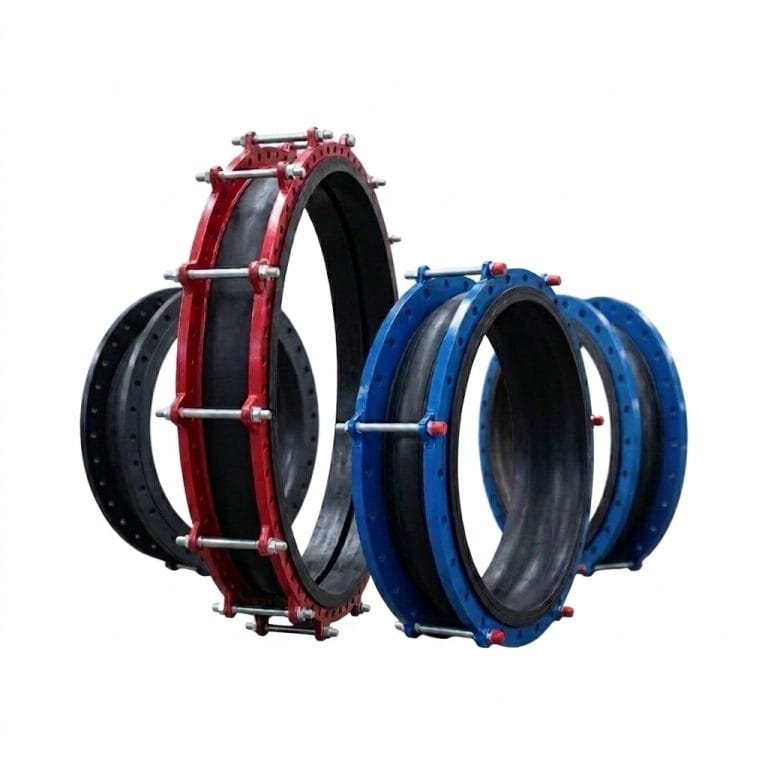
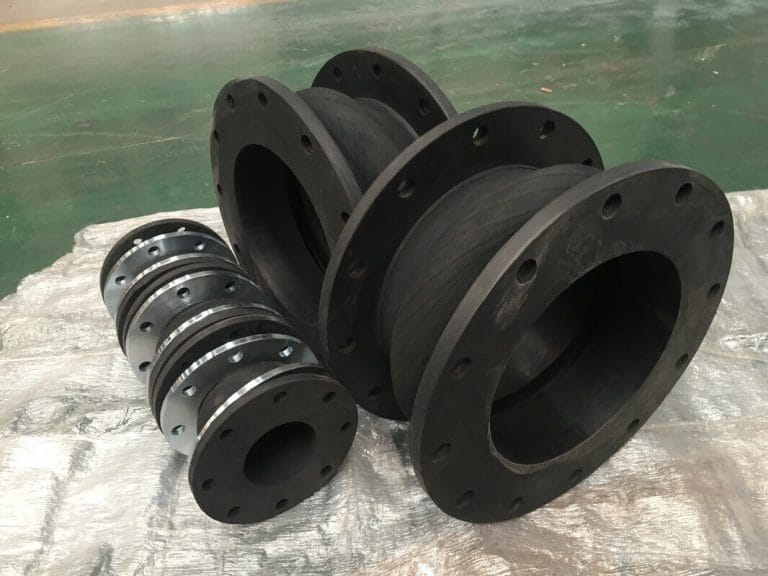
- Full Product Range: Single sphere, double sphere, reducing, elbow, and custom-molded rubber joints
- Material Expertise: EPDM, NBR, Neoprene, Butyl, Hypalon, and custom compounds
- Global Standards: ASME, DIN, JIS, GB — your drawings, our manufacturing
- In-House QC: Hydrostatic pressure testing on every joint before shipment, with test certificates provided
- Technical Support: Our engineers review your submittal packages before you award the order
- Fast Response: Engineer replies within 24 hours, standard-spec quotes within 48 hours
───────────────────────────────────────
FREQUENTLY ASKED QUESTIONS
How do I know which rubber compound to specify?
The elastomer choice depends on three factors: the transported media (water, oil, chemical, gas), the operating temperature, and environmental exposure (UV, ozone, outdoor). DEVEL’s engineering team provides compound selection guidance based on your specific operating parameters — send us your media data sheet for a recommendation.
What is the difference between single sphere and double sphere rubber expansion joints?
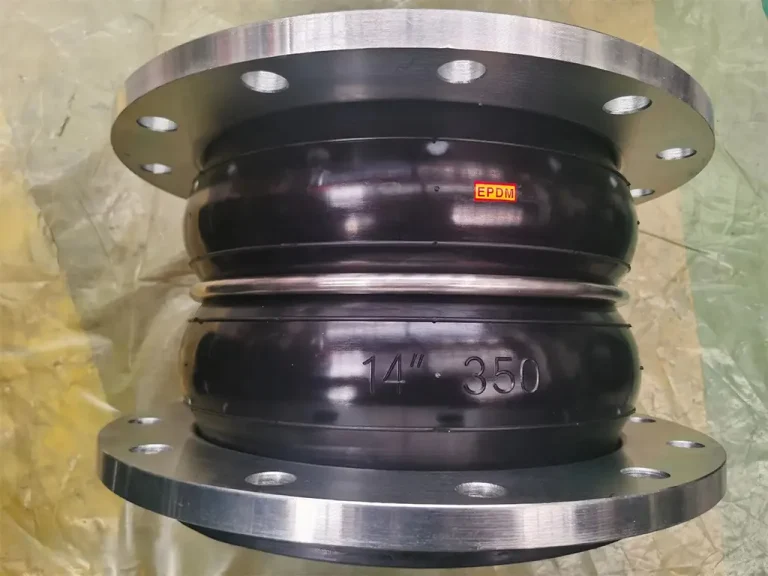
A single sphere joint has one convolution (bellows bulge) and provides standard movement absorption. A double sphere joint has two convolutions, offering approximately 2× the axial and lateral movement capacity. Double sphere joints are preferred where greater flexibility or misalignment compensation is needed, while single sphere joints offer a more compact footprint.
Do rubber expansion joints need maintenance?
Yes. DEVEL recommends visual inspection every 3–6 months: check for surface cracking, bulging, cover degradation, and bolt tightness. Joints in severe service (high temperature, abrasive media, frequent cycling) should be inspected more frequently. Typical service life is 3–7 years depending on conditions.
Can I use a rubber expansion joint for steam service?
Yes, with the correct elastomer. EPDM is the standard choice for steam applications up to approximately 120°C continuous. For higher steam temperatures, specialized compounds or alternative joint types (such as PTFE-lined) may be required. Always confirm the steam pressure and temperature with our engineering team.
───────────────────────────────────────
READY TO SOURCE YOUR RUBBER EXPANSION JOINTS?
Whether you need standard-spec joints for a quick delivery or custom-engineered solutions for a demanding project, DEVEL’s engineering team is ready to support you. Send us your completed RFQ checklist — media, temperature, pressure, movements, and flange standard — and we’ll return a customized quotation within 48 hours.
Email: info@develfluid.com
Website: https://develfluid.com/contact-us/
Phone: +86 18137171953
Henan Devel Fluid Equipment Co., Ltd. — Your Partner in Industrial Fluid Compensation Solutions.