Rubber Lined Pipes: 5 Key Advantages for Industrial Fluid Transport | DEVEL Guide
[Henan, China] — In industries where pipelines carry abrasive slurries, corrosive chemicals, or high-temperature fluids, standard steel pipes simply don’t last. Replacement cycles are short, downtime is expensive, and total operating costs spiral. This is where rubber lined pipes (also known as rubber lined steel pipes or lined rubber piping) come in — combining the structural strength of steel with the wear and corrosion resistance of industrial rubber. Henan Devel Fluid (DEVEL) breaks down the five key advantages that make rubber lined pipes the go-to choice for demanding industrial applications.
───────────────────────────────────────
WHAT IS A RUBBER LINED PIPE?
A rubber lined pipe is a composite piping system consisting of a steel outer shell (skeleton) bonded to an inner rubber lining layer using high-performance adhesives. The steel provides structural integrity and pressure resistance, while the rubber lining handles the aggressive aspects of the transported medium — absorbing impact, resisting abrasion, and preventing corrosion.
This combination solves a fundamental engineering trade-off: steel alone is strong but wears quickly under abrasive flow; rubber is highly wear-resistant but cannot withstand system pressure on its own. Together, they deliver the best of both materials in a single, cost-effective solution.
───────────────────────────────────────
5 KEY ADVANTAGES OF RUBBER LINED PIPES
- Superior Composite Structure
The steel skeleton and rubber layer are bonded into a single integrated unit using DEVEL’s proprietary high-performance adhesive technology. This overcomes the inherent weaknesses of single-material pipes:
- Steel pipes: pressure-resistant, but poor wear resistance
- Plastic/rubber pipes: wear-resistant, but cannot withstand high pressure
- FRP (fiberglass) pipes: brittle with poor impact resistance
The result is a pipe that combines the pressure capacity of steel with the abrasion resistance of rubber — delivering exceptional overall cost-effectiveness that neither material can achieve alone.
- High Strength and Impact Resistance
Rubber elastomers are inherently lightweight and possess outstanding vibration absorption and mechanical impact resistance. Key performance characteristics include:
- High strength-to-weight ratio for easier handling and installation
- Excellent rigidity with no creep deformation over time
- Strong resistance to water hammer, seismic events, and mechanical shock
- Reduced structural load on pipe supports and hangers
- Simplified transportation, on-site handling, and maintenance
- Wide Temperature Adaptability
DEVEL’s desulfurization-grade rubber lined pipes operate reliably across a broad temperature range of -50°C to +150°C (-58°F to +302°F). Crucially, the rubber lining remains firmly bonded to the steel shell throughout this range — no delamination, no separation, no leaks. This makes them particularly well-suited for flue gas desulfurization (FGD) systems where temperature cycling is a daily reality.
- Energy Saving Through Low Flow Resistance
The rubber lining offers a naturally smooth, low-friction surface that minimizes flow resistance. This translates directly to:
- Lower pumping energy consumption
- Reduced operating pressure drop across the pipeline
- Less wear on pumps and associated equipment
- Measurable savings in annual operating costs
For long-distance slurry transport or high-volume process lines, these energy savings compound significantly over the system’s service life.
- Exceptional Aging Resistance and Long Service Life
Under normal operating conditions, DEVEL rubber lined pipes deliver a theoretical service life exceeding 15 years — a substantial improvement over unlined steel alternatives in abrasive service.
Additional lifecycle benefits:
- After 6–8 years of operation, rotating the pipe approximately 90° exposes a fresh wear surface, further extending service life
- The pipe shell can be re-lined and reused up to 4 times, dramatically reducing lifecycle costs
- Short manufacturing and relining turnaround times keep projects on schedule
- Lower total cost of ownership (TCO) compared to frequent replacement of bare steel pipes
───────────────────────────────────────
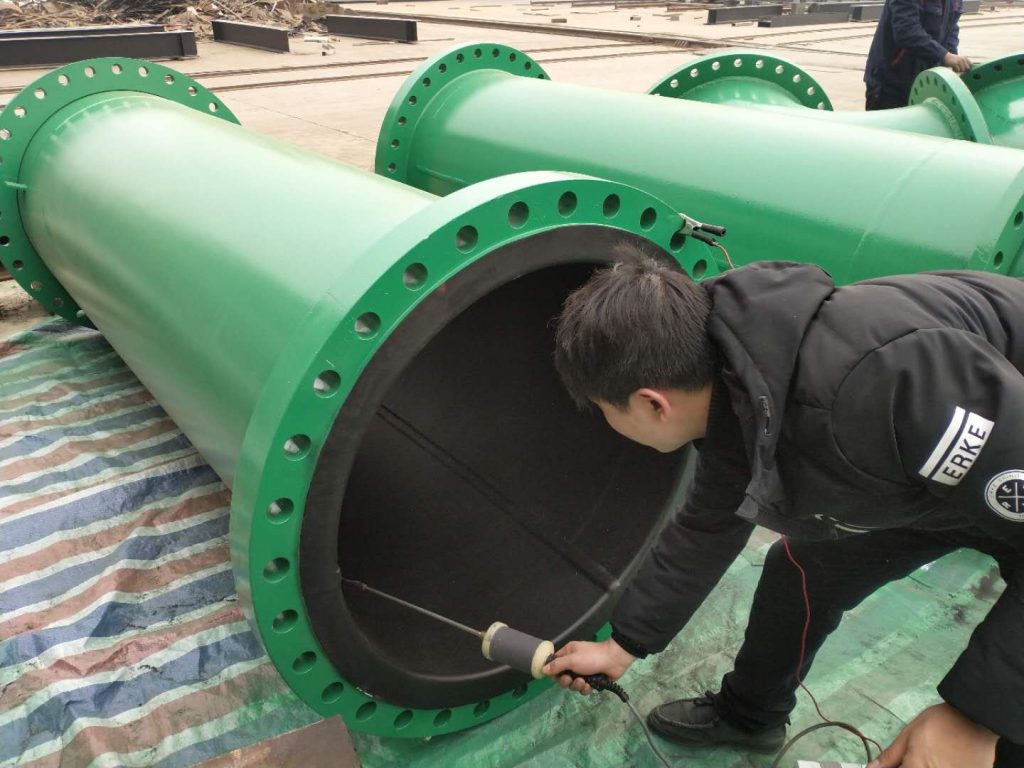
TYPICAL APPLICATIONS
DEVEL rubber lined pipes are widely deployed across industries where abrasive and corrosive media are part of daily operations:
- Flue gas desulfurization (FGD) systems in coal-fired power plants
- Mining slurry and tailings transport
- Chemical processing and acid transfer lines
- Dredging and marine sand/slurry handling
- Steel mill process water and scale handling
- Wastewater treatment with aggressive chemical content
- Fertilizer and phosphate processing
───────────────────────────────────────
RUBBER LINED PIPE VS. OTHER PIPE TYPES
Pipe Type: Bare Steel Pipe
Strength: Excellent
Wear Resistance: Poor
Corrosion Resistance: Poor
Service Life in Abrasive Service: 2–5 years
Pipe Type: Plastic / HDPE Pipe
Strength: Low to moderate
Wear Resistance: Good
Corrosion Resistance: Good
Service Life in Abrasive Service: 5–8 years
Pipe Type: FRP (Fiberglass) Pipe
Strength: Moderate
Wear Resistance: Moderate
Corrosion Resistance: Excellent
Service Life in Abrasive Service: 5–10 years
Pipe Type: Rubber Lined Steel Pipe (DEVEL)
Strength: Excellent
Wear Resistance: Excellent
Corrosion Resistance: Excellent
Service Life in Abrasive Service: 15+ years (re-lineable)
───────────────────────────────────────
WHY CHOOSE DEVEL FOR RUBBER LINED PIPES?
Henan Devel Fluid Equipment Co., Ltd. is a factory-direct manufacturer with over a decade of experience in industrial rubber lining technology. Our rubber lined pipes are engineered to your exact specifications — diameter, pressure class, rubber compound, and flange standard — not pulled from stock.
- Custom rubber formulations available: natural rubber, neoprene, EPDM, butyl, nitrile — matched to your media
- Full range of pipe diameters and lengths
- Global flange standards: ASME, DIN, JIS, GB
- In-house QC from raw material to final hydrostatic testing
- Competitive factory-direct pricing with fast global delivery
- Relining services available to extend the life of your existing pipe shells
───────────────────────────────────────
FREQUENTLY ASKED QUESTIONS
What rubber compounds are available for lining?
DEVEL offers natural rubber, neoprene (CR), EPDM, butyl rubber, and nitrile (NBR) lining options. The choice depends on the transported medium — our engineering team will recommend the optimal compound based on your temperature, chemical compatibility, and abrasion requirements.
Can existing steel pipes be retrofitted with rubber lining?
Yes. DEVEL provides relining services for existing pipe shells, subject to inspection of the steel condition. This can extend the service life of your existing pipeline infrastructure at a fraction of the cost of full replacement.
What is the maximum pipe diameter you can line?
DEVEL can handle pipe diameters ranging from DN25 to DN3000 (and larger on request), with lengths customized to your project requirements. Contact our team with your specifications for a detailed quotation.
How does rubber lined pipe compare to ceramic lined pipe?
Rubber lining excels in applications with high impact and vibration, offering superior shock absorption and flexibility. Ceramic lining provides extreme hardness for fine-particle abrasion but is more brittle. DEVEL can advise on the best choice based on your specific operating conditions.
───────────────────────────────────────
GET A CUSTOMIZED RUBBER LINED PIPE QUOTATION
Whether you need a single replacement section or a complete pipeline system, DEVEL’s engineering team is ready to support your project. Provide your operating parameters — medium, temperature, pressure, diameter, and length — and we’ll return a customized quotation within 48 hours.
Email: info@develfluid.com
Website: https://develfluid.com/contact-us/
Phone: +86 18137171953
Henan Devel Fluid Equipment Co., Ltd. — Your Partner in Industrial Fluid Transport Solutions.