Acid & Temperature Resistant Rubber Expansion Joints: The Complete Elastomer Selection Guide
1. The Problem: When Heat Meets Acid, Standard Rubber Fails Fast
If you work in chemical processing, power generation, wastewater treatment, or metallurgy, you already know the drill: your piping runs hot, your media is corrosive, and off-the-shelf rubber joints don’t last.
We see it all the time. A plant specs a standard EPDM joint for a 30% sulfuric acid line at 120°C. Three months later, the joint is swollen, cracked, or blown out. Production stops. Procurement scrambles. Everyone asks the same question: “What material should we have used?”
That’s exactly what this guide answers. We’ve compiled the elastomer performance data our engineers use every day to match rubber compounds to aggressive chemical and thermal conditions — all in one place.
🏭 Factory-Direct Reality Check
At Devel Fluid, we compound our own rubber formulations using virgin-grade polymers — no reclaimed rubber, no filler shortcuts. Every batch is traceable. Every joint is tested. We ship to 30+ countries with full ASME / DIN / JIS / BS compliance.
2. Four Elastomers for Acid & Temperature Service — Compared
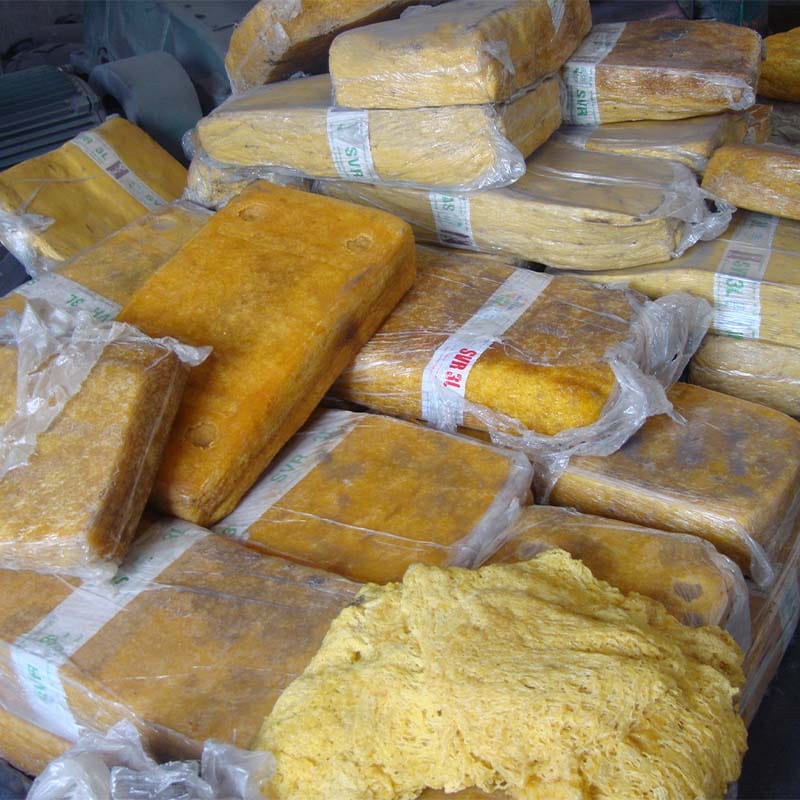
Here are the four core rubber compounds we use at Devel Fluid for chemical-resistant expansion joints. Each has a specific performance window — use the wrong one and you’re looking at premature failure. Use the right one and it’ll run for a decade or more.
🔵 EPDM (Ethylene Propylene Diene Monomer)
| Temperature Range | -40°C to +130°C (intermittent peak 150°C) |
| Acid Resistance | ★★★☆☆ — Excellent with dilute-to-medium inorganic acids (phosphoric, dilute sulfuric) |
| Best For | Chemical transfer lines, water treatment, power plant cooling loops, FGD scrubber systems |
| Do Not Use With | Petroleum-based fluids, hydrocarbon solvents, concentrated oxidizing acids |
| Cost Level | $ — Most economical option |
🔴 FKM / Viton® (Fluorocarbon Rubber)
| Temperature Range | -20°C to +200°C (intermittent peak 250°C) |
| Acid Resistance | ★★★★★ — Handles concentrated H₂SO₄, HNO₃, HCl, and mixed acid streams |
| Best For | High-spec chemical plants, refinery acid lines, petrochemical processing, hot solvent transfer |
| Do Not Use With | Low-temperature applications below -20°C; steam service |
| Cost Level | $$$ — Premium, but longest service life in aggressive media |
🟢 CSM / Hypalon® (Chlorosulfonated Polyethylene)
| Temperature Range | -35°C to +120°C |
| Acid Resistance | ★★★★☆ — Excellent with strong oxidizing acids (nitric, chromic), bleaching agents |
| Best For | Steel pickling lines, chemical storage tank connections, outdoor marine installations, highly corrosive atmospheres |
| Do Not Use With | High-temperature hydrocarbon solvents |
| Cost Level | $$ — Mid-range |
🟡 NBR — Specialty Grade (Nitrile Butadiene Rubber)
| Temperature Range | -20°C to +100°C |
| Acid Resistance | ★★☆☆☆ — Limited to specific low-concentration organic acids |
| Best For | Oily wastewater treatment, hydraulic return lines, fuel handling with trace acidic components |
| Do Not Use With | Strong inorganic acids, oxidizing chemicals, outdoor UV exposure |
| Cost Level | $ — Economical for oil-resistant applications |
2.1 Quick-Reference Comparison Table
| Property | EPDM | FKM / Viton® | CSM / Hypalon® | NBR |
|---|---|---|---|---|
| Continuous Temp | -40°C ~ +130°C | -20°C ~ +200°C | -35°C ~ +120°C | -20°C ~ +100°C |
| Intermittent Peak | 150°C | 250°C | 130°C | 120°C |
| Inorganic Acid | ★★★ Dilute to medium | ★★★★★ Concentrated | ★★★★ Oxidizing acids | ★★ Low-conc. organic |
| Oil / Fuel | ❌ Not suitable | ✅ Excellent | ⚠️ Moderate | ✅ Excellent |
| Ozone / Weather | ✅ Outstanding | ✅ Excellent | ✅ Excellent | ❌ Poor |
| Steam | ✅ Outstanding | ⚠️ Moderate | ⚠️ Moderate | ❌ Not recommended |
| Relative Cost | $ | $$$ | $$ | $ |
| Best Application | Chemical water, cooling, FGD | Strong acid piping, refinery, hot solvents | Pickling, outdoor corrosive, marine | Oily wastewater, fuel, hydraulic |
Not sure which material fits your process? Send us your media specs — our engineers will recommend the right compound within 24 hours. Request a consultation →
3. How to Choose: A 3-Step Decision Framework
Our engineers use this simple logic when matching elastomers to customer specifications:
- Start with the media. What acid? What concentration? Any solvents mixed in? → Strong acid or solvent present → FKM. Medium-strength inorganic acid → EPDM or CSM. Oil mixed in → NBR.
- Check the temperature. Above 130°C? → Only FKM can handle it. Below -40°C? → EPDM or CSM.
- Don’t ignore the environment. Outdoor installation with sun and ozone? → EPDM or CSM are your best bet. Indoor, controlled environment? → Wider options available.
⚠️ Critical Warning: EPDM + Oil = Failure EPDM swells dramatically when exposed to petroleum-based fluids — crude oil, diesel, lubricating oil, even oil mist. If your media contains any oil, you must switch to NBR or FKM. We’ve seen EPDM joints fail in under 48 hours when accidentally exposed to oil-contaminated media.
4. Beyond the Material: How Devel Fluid Builds Joints That Last Longer
Raw material selection is only half the story. The manufacturing process determines whether that material performs to its theoretical limits — or falls short. Here’s what we do differently:
4.1 Reinforced Carcass — Won’t Deform Under Heat + Pressure
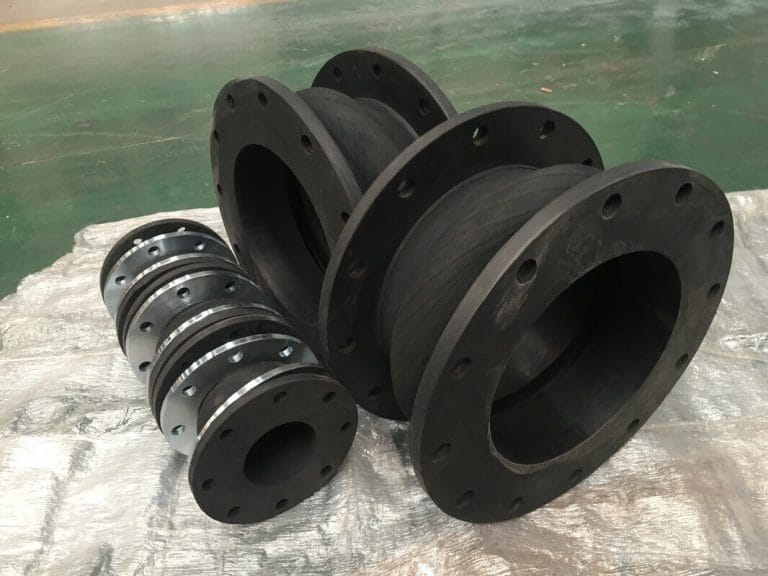
Rubber softens at high temperatures. To maintain structural integrity, we vulcanize high-tenacity nylon cord or aramid fiber plies directly into the rubber body. Think of it as the joint’s skeleton — it holds shape when temperatures climb and pressures spike.
4.2 Seamless Inner Tube — No Path for Acid to Creep In
A common failure mode in cheaper joints: acid penetrates the seam where the inner liner joins, attacks the fabric reinforcement, and the joint delaminates from the inside out. Our inner tubes are compression-molded as a single seamless piece. No joint. No weak point. No hidden degradation.
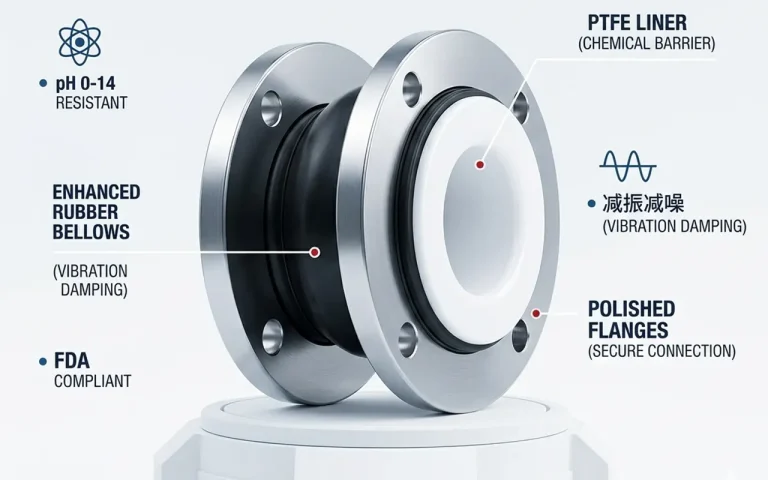
4.3 PTFE Lining — When Rubber Alone Isn’t Enough
For concentrated acids (98% H₂SO₄), hydrofluoric acid, or aggressive organic solvents, even FKM has limits. That’s where our PTFE-lined composite joints come in.
Standard Rubber Joint
- Chemical attack degrades rubber over time
- Small-molecule solvents permeate the liner
- Replacement every 6–24 months in aggressive service
PTFE-Lined Joint (Devel Fluid)
- PTFE barrier — pH 0–14, virtually inert to all industrial chemicals
- Zero permeation — molecularly bonded liner blocks solvent migration
- 8–15 year service life in the same conditions
The PTFE liner is chemically-mechanically bonded to the rubber substrate at the molecular level — not mechanically attached with adhesives that fail under vacuum or thermal cycling. The outer rubber body handles the flexing, vibration absorption, and movement compensation. The inner PTFE handles the chemical attack. Each layer does what it does best.
✅ Where PTFE-Lined Joints Are Specified Semiconductor fab acid waste lines (HF, H₂SO₄, H₂O₂), lithium battery NMP solvent systems, chlor-alkali plants, pharmaceutical API production — anywhere chemical purity and absolute corrosion resistance are non-negotiable.
5. What We Test Before Your Joint Leaves the Factory
Every batch of chemical-resistant rubber expansion joints from Devel Fluid passes five mandatory tests. No exceptions.
| Test | Method | Pass Criteria |
|---|---|---|
| Accelerated Aging | Extended exposure to elevated temperature in controlled chamber | Tensile strength retention ≥ 80% |
| Acid Immersion | Immersion in specified acid concentration at operating temperature | Weight change ≤ 5%, volume swell ≤ 10% |
| Hydrostatic Burst | Progressive pressure increase to failure | Burst pressure ≥ 3× rated working pressure (3:1 safety factor) |
| Full Vacuum | Simulated full vacuum conditions | No collapse, no liner separation |
| Cyclic Fatigue | Axial, lateral, and angular cycling under rated pressure | Zero cracks, zero leaks through specified cycles |
6. Frequently Asked Questions
Which rubber material offers the best acid resistance for expansion joints?
FKM (Viton® fluoroelastomer) delivers the highest acid resistance among single-material options — it handles concentrated sulfuric, nitric, and hydrochloric acids at temperatures up to 200°C. For the most extreme chemical environments, our PTFE-lined composite joints provide universal pH 0–14 resistance regardless of acid type or concentration.
What’s the maximum operating temperature for EPDM expansion joints?
Standard EPDM operates continuously from -40°C to +130°C, with intermittent capability to 150°C. Beyond that, EPDM’s mechanical properties degrade rapidly. For sustained high-temperature service, switch to FKM (200°C continuous / 250°C intermittent).
When do I need PTFE lining instead of just FKM rubber?
Spec PTFE lining when your process involves: (1) concentrated strong acids above 50%, (2) hydrofluoric acid at any concentration, (3) organic solvents like NMP, acetone, or toluene that penetrate rubber at the molecular level, or (4) applications requiring ultra-high purity with zero extractables (semiconductor, pharmaceutical).
How long should a properly-specified acid-resistant rubber joint last?
With correct material selection and proper installation: EPDM: 15–25 years in mild acid service, FKM: 8–15 years in concentrated acid service, PTFE-lined: 8–15 years in extreme chemical environments. The #1 cause of early failure is material misselection — a standard EPDM joint in concentrated acid can fail in as little as 3 months.
What information do you need to quote a chemical-resistant rubber expansion joint?
Four data points get you an accurate quote: (1) Media type and concentration (e.g., 30% H₂SO₄), (2) Operating temperature and working pressure, (3) Nominal diameter (DN) and face-to-face length, (4) Flange drilling standard (ANSI 150 / DIN PN10 / BS Table D / JIS 10K). Our engineers respond with a material recommendation and pricing within 24 hours.
Get a Material Recommendation & Quote — Within 24 Hours
Stop guessing. Send us your process conditions and our engineering team will recommend the right elastomer compound for your application.
- ✓ Media type & concentration (e.g., 30% Sulfuric Acid)
- ✓ Operating temperature & working pressure
- ✓ Nominal diameter (DN) & overall length
- ✓ Flange standard (ANSI / DIN / BS / JIS)
Request Technical Consultation & Quote →