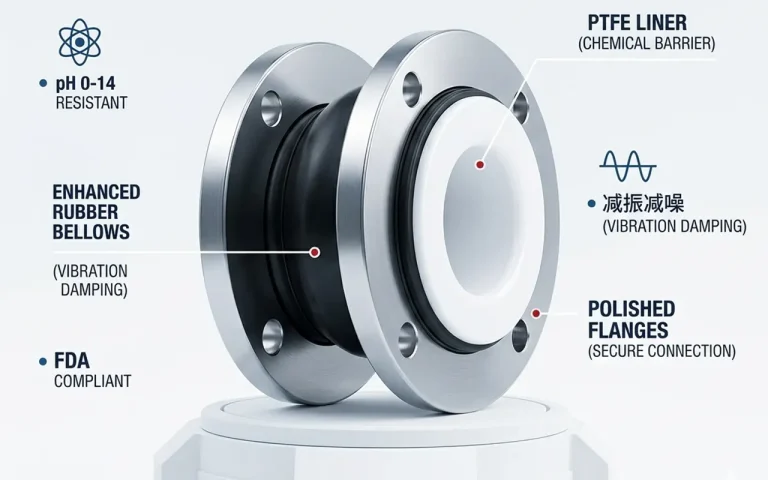
Large-Diameter Rubber Expansion Joint Overseas Shipping & Logistics Solution
Executive Summary Shipping large-diameter rubber expansion joints (DN500–DN3000) across continents is not a simple “put it in a box and ship it” operation. These flexible connectors are precision-engineered elastomeric products — they’re heavy (often exceeding 2–5 tons per unit for the largest sizes), dimensionally irregular, and sensitive to environmental conditions. A poorly executed shipping plan…
A Complete Guide for DN500–DN3000 Industrial Rubber Joints Export from China
Executive Summary
Shipping large-diameter rubber expansion joints (DN500–DN3000) across continents is not a simple “put it in a box and ship it” operation. These flexible connectors are precision-engineered elastomeric products — they’re heavy (often exceeding 2–5 tons per unit for the largest sizes), dimensionally irregular, and sensitive to environmental conditions. A poorly executed shipping plan leads to damaged rubber surfaces, deformed flanges, and rejected shipments at destination ports.
Henan Devel Fluid Equipment Co., Ltd. has shipped rubber expansion joints to over 30 countries worldwide, covering markets across Southeast Asia, the Middle East, Africa, Europe, and the Americas. This article distills our field-proven experience into a comprehensive overseas shipping framework — from factory packaging to destination handover.
1. Understanding What You’re Shipping: The Product Profile
Before designing any logistics plan, you must understand the product’s physical characteristics and vulnerabilities.
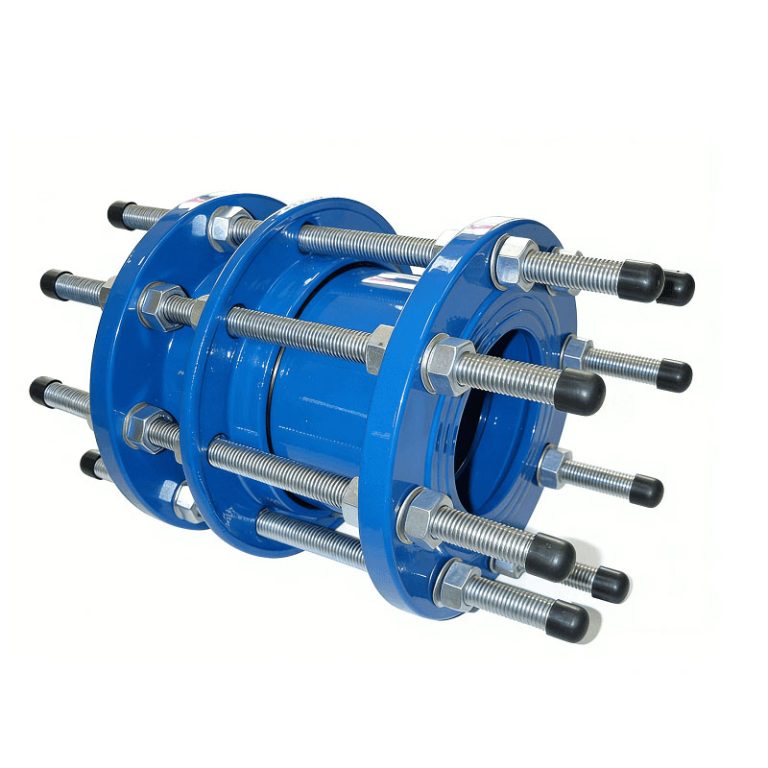
1.1 Large Rubber Expansion Joints — Key Parameters
| Parameter | Typical Range (Devel Fluid Capability) |
|---|---|
| Nominal Diameter | DN32 – DN3000 (1.25″ – 120″) |
| Face-to-Face Length | 130mm – 400mm+ (varies by diameter) |
| Unit Weight | ~50 kg (DN500) up to 3,500+ kg (DN3000) |
| Elastomer Types | EPDM, NBR, Neoprene, Natural Rubber, SBR |
| Flange Material | Carbon Steel Q235 (galvanized/coated), SS304, SS316 |
| Pressure Ratings | PN10 / PN16 / PN25, Class 150 / 300 |
| Standards Compliance | GB, ASME/ANSI B16.5, DIN, BS, EN1092, JIS |
1.2 Critical Vulnerabilities During Transit
These are the five things that will ruin a rubber expansion joint in transit — and how we prevent each one:
| Risk Factor | Consequence | Prevention Strategy |
|---|---|---|
| Sharp Object Contact | Cuts, punctures, or scoring on rubber surface → seal failure | Full bubble-wrap encapsulation + rigid crate separation |
| UV / Sunlight Exposure | Accelerated rubber aging, surface cracking | Opaque, sealed packaging; containerized shipping |
| Moisture & Humidity | Corrosion on carbon steel flanges, mold on rubber | Desiccant packs + moisture barrier wrapping |
| Improper Stacking / Compression | Permanent deformation of rubber arch | Reinforced crates rated for stacking; “NO STACK” marking when needed |
| Impact & Vibration | Flange damage, rubber-to-metal bond separation | Shock-absorbing internal bracing; crates engineered for 3G+ loads |
2. Pre-Shipping Preparation: Factory-Side Packaging Engineering
2.1 Packaging Environment Requirements
All packaging operations must be performed indoors in a controlled environment. Before packaging:
- Clean all surfaces: Remove dust, fillers, debris, grease, and any process contamination from both interior and exterior surfaces of the rubber joint.
- Moisture-proof treatment: Ensure the product is completely dry. For carbon steel flanges, apply anti-rust coating (VCI — Volatile Corrosion Inhibitor — recommended for ocean freight).
- Inspect rubber surfaces: Any existing cuts, abrasions, or manufacturing defects must be documented and resolved before packaging.
2.2 Multi-Layer Packaging System
Our standard packaging protocol for large rubber expansion joints uses a four-layer protection system:
Layer 1: Product Surface Protection
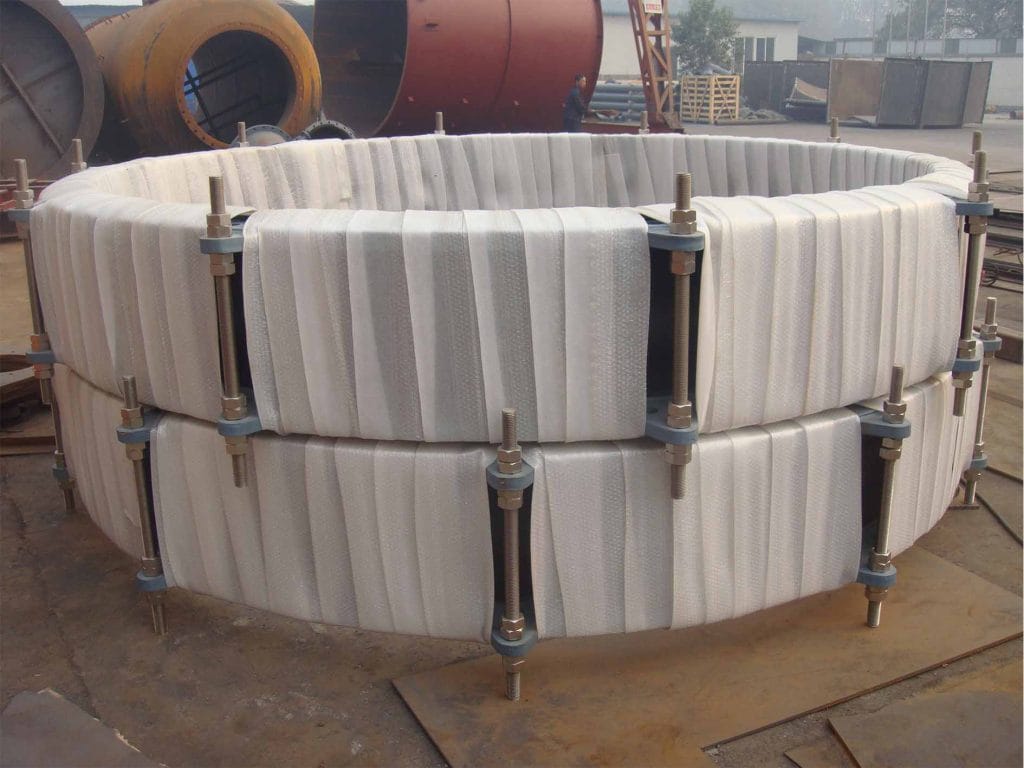
- The entire rubber joint body is wrapped in bubble polyethylene sheeting (minimum 2 layers).
- Flange faces are protected with plywood covers bolted in place, preventing flange surface damage and protecting the raised face / serrated finish.
- Connecting bolts, nuts, and gaskets are bagged separately in VCI anti-rust bags and secured inside a dedicated compartment within the main crate.
Layer 2: Internal Bracing & Fixation
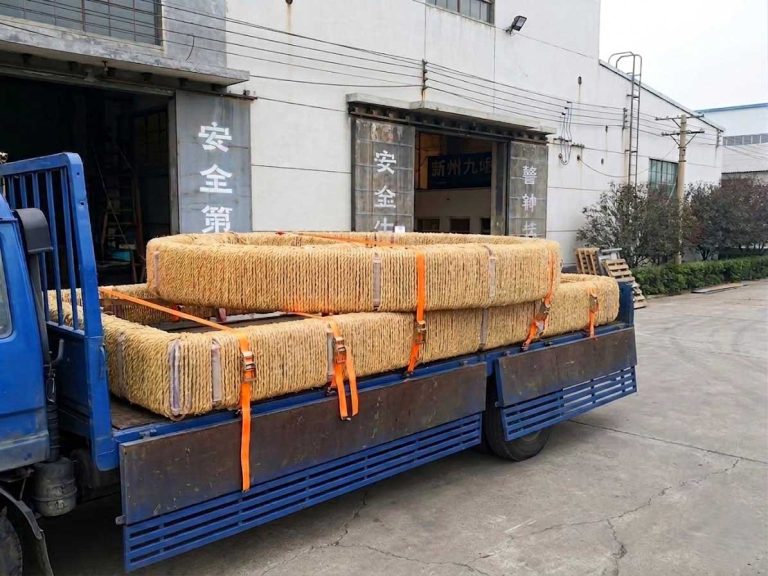
- The wrapped rubber joint is secured to the crate base using nylon lifting slings (never steel chains or wire rope — these cut rubber).
- Internal wooden cross-bracing prevents lateral movement during handling and transit.
- For joints with tie-rod limiters or control units, these are individually wrapped and fixed to prevent swinging.
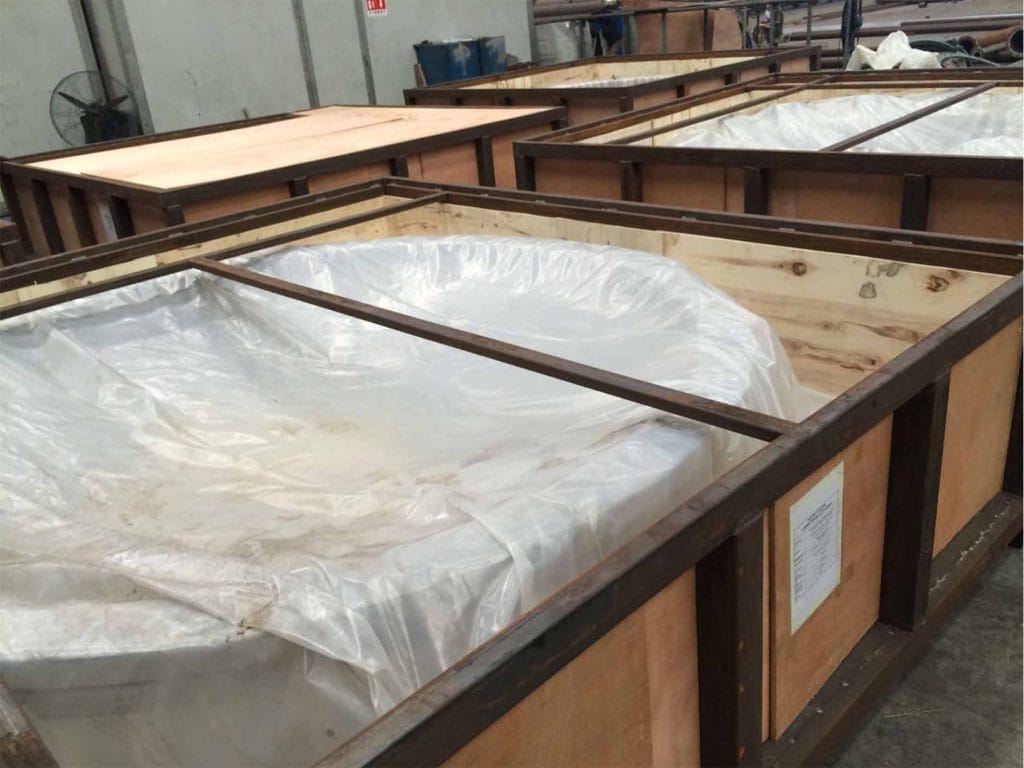
Layer 3: Structural Crating
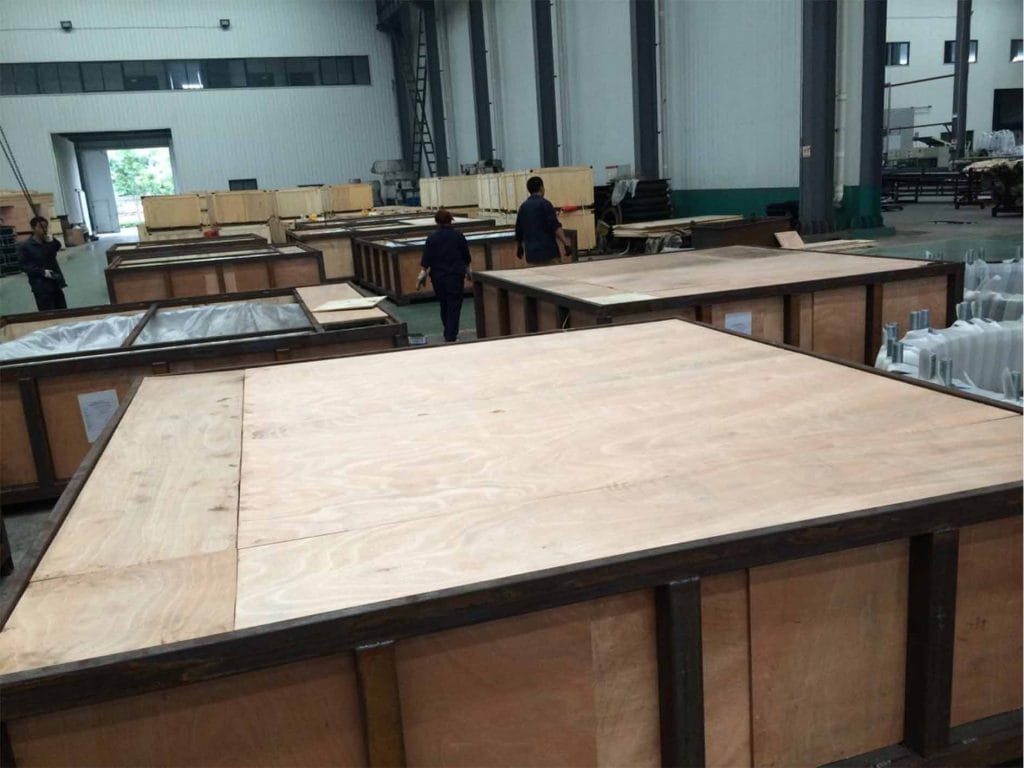
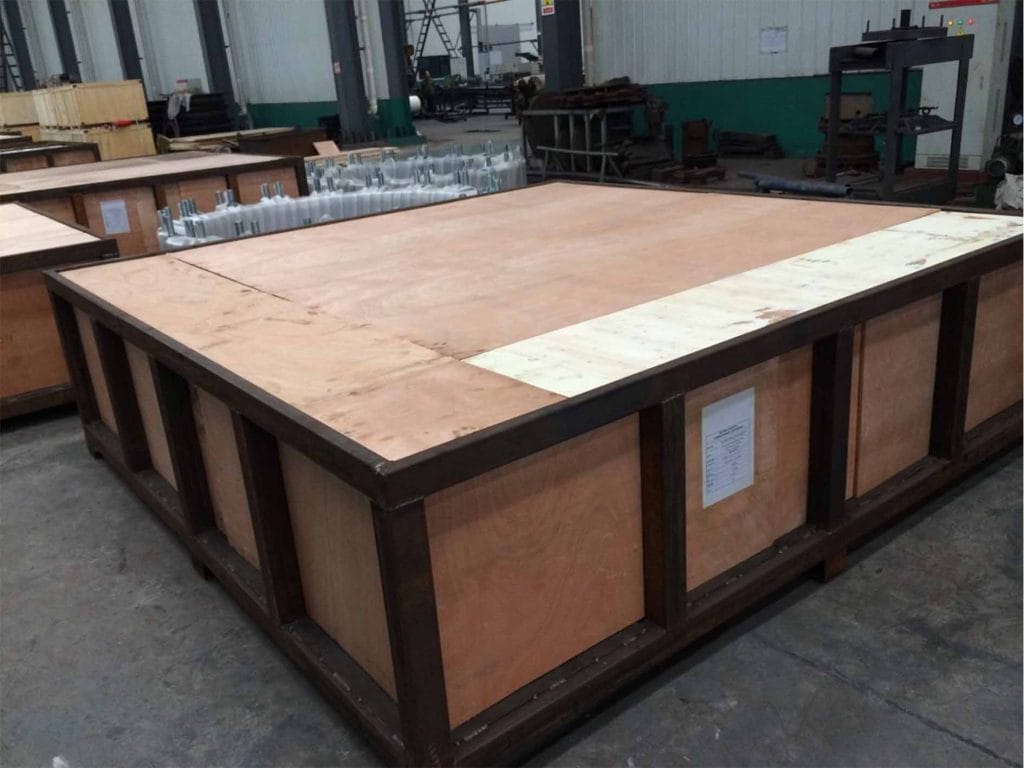
For large-diameter joints (DN500+), we use steel-frame + plywood composite crates:
| Crate Component | Specification |
|---|---|
| Frame Material | Structural steel angle (minimum 50×50×5mm) or welded steel tube frame |
| Panel Material | 18mm+ fumigation-free plywood (ISPM-15 compliant) |
| Base | Reinforced with forklift channels (4-way entry) |
| Stacking Capacity | Rated to safely support one identical loaded crate stacked on top |
| Internal Clearance | Minimum 100mm between product and crate walls on all sides |
Typical crate dimensions for large joints (example):
- DN2000 single sphere joint: approx. 3,300 × 3,300 × 1,380 mm (L×W×H)
- Multiple smaller joints (e.g., DN500–DN800) can be packed 2 units per crate
Layer 4: Weather Barrier
- The entire crate interior is lined with waterproof composite membrane (aluminum foil + PE laminate).
- Silica gel desiccant packs (minimum 500g per m³ of crate volume) are placed inside.
- External crate surfaces are treated with water-resistant coating or wrapped with waterproof tarpaulin for open-top container shipments.
2.3 Fumigation-Free Compliance
All wood materials used in packaging must be ISPM-15 compliant (heat-treated and stamped) or made from manufactured wood products (plywood, OSB) that are exempt. This is non-negotiable for international shipping — non-compliant wood will be rejected at destination customs or require costly on-arrival fumigation.
3. Marking & Labeling: The Shipping Mark System
Proper marking is the difference between a crate that arrives correctly and one that gets lost, mishandled, or damaged. All markings must be bilingual (Chinese + English).
3.1 Mandatory Shipping Marks
[SHIPPING MARK LAYOUT — painted/stenciled on 2 adjacent sides of each crate]

CONSIGNEE: [Company Name]
DESTINATION: [Port/City, Country]
CONTRACT NO: [XXX-XXXX]
PACKAGE NO: [XX / XX]
GROSS WEIGHT: [XXXX kg]
NET WEIGHT: [XXXX kg]
DIMENSIONS: [L×W×H mm]
ORIGIN: P.R. CHINA
MADE IN CHINA
3.2 Handling Instruction Pictograms
The following ISO-standard handling symbols must be prominently displayed:
| Symbol | Meaning | When Required |
|---|---|---|
| ☂️ (Umbrella) | KEEP DRY | Always |
| ⬆️ (Arrows Up) | THIS WAY UP | Always |
| 🍷 (Wine Glass) | FRAGILE — HANDLE WITH CARE | Always |
| 🚫⬆️ (Arrows Up with X) | DO NOT TIP | Joints > DN1000 |
| ⛓️🚫 (Chain with X) | DO NOT USE CHAINS FOR LIFTING | Always |
| 📦📦 (Stacked Boxes with Limit) | STACKING LIMIT: 1 | When applicable |
3.3 Additional Markings for Project Cargo
For large project shipments (EPC projects, power plants, industrial facilities):
- Item tag number matching the project P&ID or equipment list
- Storage class (indoor/outdoor, temperature range: 5°C – 40°C)
- Preservation period (e.g., “Do not unpack before installation — valid until YYYY-MM-DD”)
4. Container Loading & Consolidation Strategy
4.1 Container Selection by Joint Size
| Joint Diameter (DN) | Recommended Container Type | Typical Load |
|---|---|---|
| DN32 – DN300 | 20ft GP (General Purpose) | 20–60 units |
| DN350 – DN600 | 40ft GP or 40ft HC (High Cube) | 8–20 units |
| DN700 – DN1200 | 40ft HC or 40ft Open Top | 2–8 units |
| DN1400 – DN2400 | 40ft Flat Rack or 40ft Open Top | 1–2 units |
| DN2600 – DN3000 | Breakbulk / Flat Rack / RO-RO | 1 unit per platform |
4.2 Loading Sequence & Securing
- Heaviest crates loaded first, positioned at the container floor center (front of container for road transport, center for sea).
- Load distribution: Maintain even weight distribution across the container floor. Maximum floor load for standard 40ft container: ~5,500 kg/m linear.
- Securing method:
- Steel strapping bands (minimum 2 per crate) tensioned to container lashing rings
- Wooden chocks nailed to container floor to prevent lateral sliding
- Air bags (dunnage bags) inserted between crates when multiple units share a container
- Void space: Any remaining void must be filled with dunnage or air bags to prevent load shift during ocean transit.
4.3 Special Considerations for Open-Top & Flat Rack
- Crates must be wrapped with reinforced waterproof tarpaulin (UV-stabilized, minimum 200g/m² PE fabric).
- Tarpaulin must be secured with rope lashing through crate anchor points — not simply draped over.
- For flat rack shipments, the crate base must be engineered with lifting lugs for crane handling at both origin and destination.
5. Transportation Mode Selection
5.1 Mode Comparison
| Mode | Transit Time (China → Middle East example) | Cost Index | Best For |
|---|---|---|---|
| FCL Sea Freight | 20–35 days | $$ | Most shipments; best balance of cost and protection |
| LCL Sea Freight | 25–40 days | $$$ | Small orders (1–3 small joints) |
| Breakbulk / Project Cargo | 25–45 days | $$$$ | Oversized DN2600+ joints; EPC project shipments |
| Air Freight | 3–7 days | $$$$$ | Emergency replacements; small joints only (< DN300) |
| Rail Freight (China-Europe) | 15–20 days | $$$ | Europe-bound shipments; faster than sea, cheaper than air |
5.2 Route Planning Considerations
For large rubber expansion joints shipping from Zhengzhou, Henan (central China):
Typical Export Gateway:
- Shanghai Port (~900 km, truck 1–2 days) — primary gateway
- Qingdao Port (~700 km, truck 1 day) — northern routes
- Tianjin Port (~600 km, truck 1 day) — northern routes
- Lianyungang Port (~500 km, truck < 1 day) — nearest sea port
Inland Truck Transport Requirements:
- Low-bed trailers for oversized crates (height > 2.5m on standard trailer)
- Route survey for bridge/tunnel clearance if crate height exceeds 4.2m
- Permit for over-dimensional cargo if width > 2.5m or height > 4.0m (China highway regulation)
6. Lifting & Handling Protocol
6.1 At Factory & Port
⚠️ CRITICAL RULE: Never use steel chains or wire ropes directly on rubber expansion joints. The rubber surface will be cut, scored, or permanently damaged.
Approved Lifting Methods:
- Nylon slings (flat woven webbing) — Primary method. Use minimum 2 slings, positioned at the crate lifting points.
- Forklift with padded forks — For crates with forklift channels. Ensure forks are fully inserted and padded if contacting the crate interior.
- Spreader bar + nylon slings — For large single-unit crates (>3 tons) to prevent lateral compression.
Prohibited Practices:
- ❌ Steel wire rope directly on any rubber surface
- ❌ Single-point lifting (creates unbalanced load, crate damage)
- ❌ Forklift tines contacting rubber directly (even through packaging — use crate base only)
- ❌ Dragging or sliding crates across surfaces
6.2 At Destination — Site Handling
- Rubber expansion joints should be stored in their original crates until immediately before installation.
- Storage location: covered, away from heat sources (> 1m distance), away from oils, acids, alkalis, and organic solvents.
- Storage temperature: 5°C – 40°C ambient.
- If inspection requires opening the crate, re-seal it after inspection.
- Do not stack crates containing rubber joints unless the crate is specifically rated for stacking (and even then, limit to 1-on-1).
7. Documentation Package
Every international shipment must include a complete documentation package. Missing paperwork is one of the top three causes of customs clearance delays.
7.1 Core Shipping Documents
| Document | Purpose | Notes |
|---|---|---|
| Commercial Invoice | Customs valuation, duties assessment | Must match packing list quantities exactly |
| Packing List | Cargo verification | Include crate dimensions, weights, and contents per crate |
| Bill of Lading (B/L) | Title document, cargo release | Ensure “Clean on Board” notation |
| Certificate of Origin | Preferential tariff eligibility | Form E (ASEAN), Form F (Chile), CO (general) |
| Fumigation Certificate | ISPM-15 compliance proof | Only if solid wood used; not required for plywood-only crates |
7.2 Product-Specific Documents
| Document | Purpose |
|---|---|
| Material Test Certificate (MTC) | Verifies elastomer compound and flange material grade |
| Pressure Test Report | Hydrostatic test results (typically 1.5× working pressure) |
| Inspection Certificate | Third-party or factory QC sign-off |
| Installation & Storage Instructions | On-site handling guidance for receiving team |
| Packing Photo Report | Photo documentation of each crate before sealing — invaluable for insurance claims |
7.3 Customs-Specific (China Export)
- Customs Declaration Form — Filed via China Customs Integrated System
- HS Code for Rubber Expansion Joints: 4016.99 (other articles of vulcanized rubber) or 7307.99 (steel flange fittings) — verify with your customs broker based on the predominant material and function
- Export License: Not required for standard industrial rubber joints (non-dual-use)
8. Insurance & Risk Management
8.1 Insurance Coverage Recommendations
| Coverage Type | What It Covers | Recommendation |
|---|---|---|
| Institute Cargo Clauses (A) | All risks — most comprehensive | Strongly recommended for shipments > $10,000 |
| Institute Cargo Clauses (B) | Named perils | Minimum acceptable |
| Institute Cargo Clauses (C) | Limited perils | Not recommended for rubber joints |
| War & Strikes Clause | Political risks | Recommended for high-risk regions |
| Warehouse-to-Warehouse | Full logistics chain | Verify this is included in your policy |
8.2 Claims Prevention
- Photograph every crate from all 6 sides before loading (with date stamp).
- Photograph the loaded container with doors open and closed.
- Record container and seal numbers on all shipping documents.
- Inspect cargo within 3 days of arrival — late discovery of damage voids most insurance claims.
9. The Devel Fluid Advantage: Why Our Shipping Process Works
Henan Devel Fluid Equipment Co., Ltd. is not just a manufacturer — we are a registered customs declarant with direct export capability:
- Customs Registration No.: 4101960NQL
- Inspection & Quarantine Code: 8410012435
- Factory-direct shipping: No middlemen, no trading company handoffs, full quality control from raw material to loaded container
- International standards compliance: We manufacture to GB, ASME/ANSI B16.5, DIN, BS, EN1092, and JIS — so what arrives matches what your project specs require
- 30+ countries served: Our packaging and logistics protocols have been stress-tested across tropical, arctic, and maritime environments
- Engineering support: Our team responds within 24 hours with technical documentation, packing plans, and shipping schedules
10. Checklist: Pre-Shipment Verification
Use this checklist before every international shipment of large rubber expansion joints:
- All rubber surfaces cleaned, dry, and inspected
- Flange faces protected with plywood covers
- Carbon steel flanges treated with anti-rust coating (VCI)
- Product wrapped in minimum 2 layers of bubble polyethylene
- Crate structure (steel frame + plywood) inspected for integrity
- All wood material ISPM-15 compliant (fumigation-free)
- Desiccant packs placed inside crate
- Product secured with nylon slings (not steel) to crate base
- Internal bracing prevents all 6-axis movement
- Shipping marks (bilingual) painted on 2 adjacent sides
- Handling pictograms correctly displayed
- Packing list matches crate contents exactly
- Photos taken of open crate (contents visible) and sealed crate (all sides)
- Container inspection passed (clean, dry, no holes)
- Container seal number recorded
- Insurance coverage confirmed
- Full documentation package ready
11. Case Study Reference: CPHGC 2×660MW Coal-Fired Power Project
Our packaging and shipping methodology was validated on the CPHGC 2×660MW Coal-Fired Power Project (China Power Hub Generation Company), where we supplied rubber expansion joints for critical piping systems. Key metrics from this project:
- 8 large-diameter rubber expansion joints shipped in 4 custom crates
- Crate specification: Steel frame + wood composite, 3,300 × 3,300 × 1,380 mm
- 2 joints per crate with centralized bolt kit compartment
- Zero transit damage over sea freight from China to Pakistan
- Full bilingual documentation (Chinese + English) compliant with project specifications
12. Ready to Ship? Contact Our Engineering Team
Every shipment is different. Large-diameter rubber expansion joints may require customized crate engineering, specialized transport arrangements, or project-specific documentation packages.
Henan Devel Fluid Equipment Co., Ltd.
- 🌐 Website: www.develfluid.com
- 📧 Email: info@develfluid.com
- 📱 WhatsApp: +86 18137171953
- 📍 Address: Innovation Complex A2045, No. 27 Industrial Road Street, Shangjie District, Zhengzhou, Henan, P.R. China
Get a shipping quote within 48 hours — provide your joint specifications (DN, quantity, elastomer type, destination port) and we’ll return a complete logistics proposal including packaging plan, crate drawings, shipping schedule, and door-to-port cost breakdown.