PTFE Lined Rubber Expansion Joint: The Complete Guide to Chemical-Resistant Flexible Connectors
In the realm of high-end industrial fluid control, Develfluid is committed to solving connection stability challenges under the most extreme operating conditions. FWhen industrial pipelines carry highly corrosive chemicals at elevated temperatures, conventional rubber expansion joints degrade within months. PTFE lined rubber expansion joints solve this problem by combining the chemical inertness of polytetrafluoroethylene (PTFE) with the flexibility of elastomeric materials. At Develfluid, we engineer these dual-phase composite connectors to withstand the most aggressive media — from semiconductor-grade acids to lithium battery solvents — while maintaining full multi-axis displacement compensation.
This article covers how PTFE lined rubber expansion joints work, how they compare to alternatives, and where they deliver the highest value across industrial applications.
1. Why Standard Rubber Expansion Joints Fail in Corrosive Service
Rubber expansion joints are widely used to absorb vibration, compensate for thermal expansion, and reduce noise in piping systems. However, when the conveyed medium is chemically aggressive, standard elastomers face three critical failure modes:
- Chemical Degradation: Strong acids (sulfuric, hydrochloric, nitric), organic solvents (NMP, acetone, toluene), and high-temperature caustic solutions attack the polymer chains of natural rubber, EPDM, and nitrile — causing swelling, embrittlement, and eventual rupture. A joint rated for 5 years may fail in 5 months.
- Permeation & Blistering: Small-molecule solvents penetrate the rubber matrix, forming blisters between the inner liner and carcass. When pressure cycles, these blisters collapse and delaminate the lining — a failure mode invisible to external inspection.
- Scaling & Flow Restriction: Crystallization-prone media adhere to rubber’s relatively rough surface, building deposits that reduce effective pipe diameter and increase pumping energy costs over time.
These failures drive unplanned downtime, safety incidents, and higher total cost of ownership (TCO). The solution? A chemically inert barrier that shields the rubber body without sacrificing its mechanical flexibility.
2. How PTFE Lined Rubber Expansion Joints Work
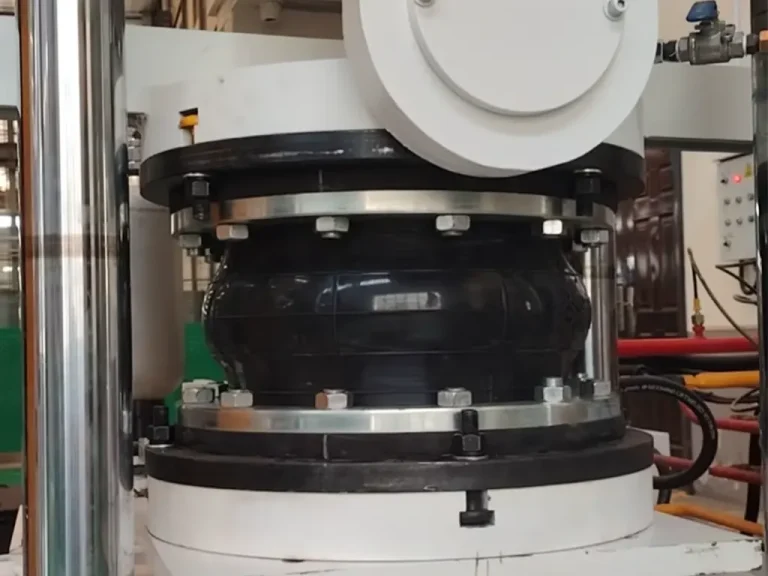
A PTFE lined rubber expansion joint (also known as a Teflon® lined rubber flexible connector) uses a dual-layer composite construction:
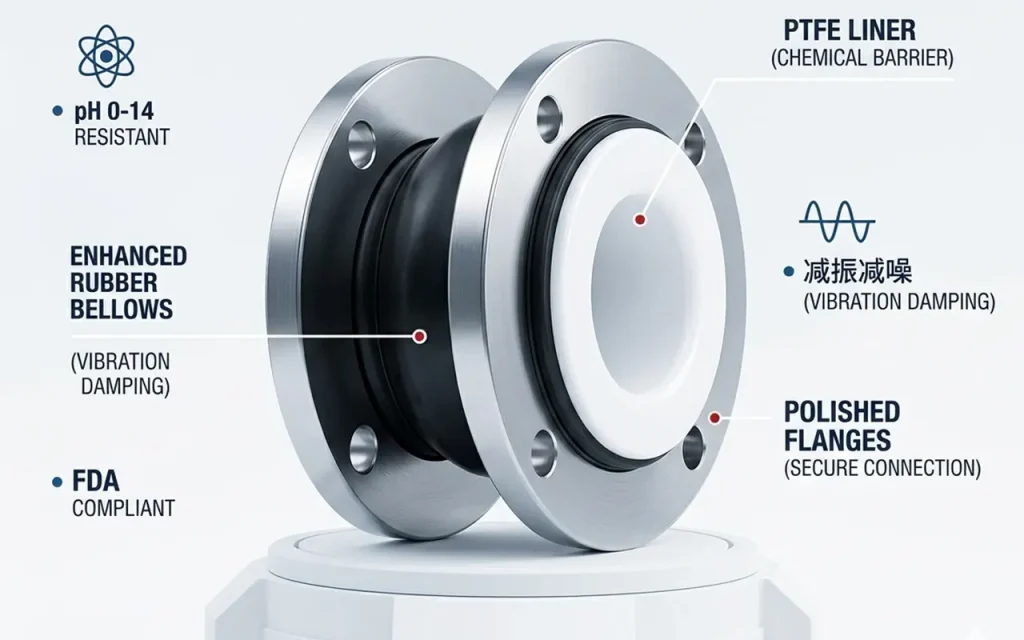
- Inner PTFE Lining: An integrally compression-molded polytetrafluoroethylene layer forms the wetted surface. PTFE is virtually universal in chemical resistance (pH 0–14), has a service temperature range of -50°C to +260°C, and possesses the lowest coefficient of friction of any solid material (<0.1).
- Outer Rubber Body: High-grade EPDM (or FKM for extreme temperatures) provides the structural flexibility — absorbing axial compression/extension, lateral offset, and angular deflection. The rubber layer handles the mechanical work while the PTFE handles the chemical exposure.
This composite design delivers what neither material can achieve alone: full chemical protection plus full dynamic motion compensation at operating pressures up to 1.6 MPa (232 PSI) and beyond.
2.1 Performance Comparison: PTFE Composite vs. Metal vs. Plastic-Lined
| Performance Metric | PTFE Lined Rubber Expansion Joint | All-Metal Bellows Compensator | PTFE-Lined Rigid Pipe (No Flex) |
|---|---|---|---|
| Chemical Resistance | Universal (pH 0–14, all common solvents) | Limited — depends on alloy grade (Hastelloy, titanium add significant cost) | High, but only at static joints |
| Axial / Lateral / Angular Compensation | Excellent — 15–20% axial, ±30° angular | Moderate — low cycle fatigue life under combined loading | None — rigid connection transfers all stress to flanges |
| Vibration Damping | Superior — rubber absorbs high-frequency pump vibration | Poor — metal transmits vibration; requires separate dampers | None |
| Media Purity | FDA-compliant, non-leaching, no metal ion contamination | Risk of metal ion release — critical for semiconductor UHP applications | Good |
| Lifecycle Cost | Low — 8–15 year service life with zero maintenance | High — requires periodic NDT crack inspection; replacement cycle 3–7 years in corrosive service | Moderate — but high when factoring in downstream fatigue failures |
| Weight | Light — easy to install without heavy lifting equipment | Heavy — may require structural support modifications | Moderate |
Table 1: Head-to-head comparison of PTFE lined rubber expansion joints versus alternative connection technologies.
2.2 Key Technical Advantages of the Develfluid PTFE Composite Design
- Integral Flared Sealing Face: The PTFE liner extends over the flange face, creating a PTFE-to-PTFE seal when mated. No separate gasket is required — eliminating the most common leak path in conventional lined joints where the gasket material is chemically attacked.
- Wide Temperature Range: The advanced bonding process between PTFE and EPDM maintains structural integrity from -50°C to +180°C (-58°F to +356°F). For higher-temperature applications, FKM-based constructions extend to +200°C.
- Self-Lubricating Low-Friction Surface: PTFE’s friction coefficient below 0.1 minimizes flow resistance. In high-viscosity slurry applications, this prevents material buildup and reduces pumping energy consumption by up to 8–12% compared to unlined rubber joints.
- Molecular-Level Bonding: Unlike mechanically attached liners that can delaminate under vacuum or cyclic loading, the Develfluid process achieves a permanent chemical-mechanical bond between PTFE and the rubber substrate — tested to withstand full vacuum service without collapse.
3. Industrial Applications of PTFE Lined Expansion Joints
3.1 Semiconductor Wet Processing & Fine Chemicals
In semiconductor fabrication, ultra-high-purity (UHP) chemicals — including hydrofluoric acid (HF), sulfuric acid (H₂SO₄), hydrogen peroxide (H₂O₂), and tetramethylammonium hydroxide (TMAH) — are transported at precise temperatures and flow rates. Even parts-per-trillion metallic contamination can destroy wafer yields.
PTFE lined rubber expansion joints address this by providing a fully inert, non-leaching wetted surface while absorbing the pulsation from diaphragm and bellows pumps common in wet bench and CMP (chemical mechanical planarization) slurry delivery systems.
3.2 Flue Gas Desulfurization (FGD) & Marine Engineering
Flue gas desulfurization systems in coal-fired power plants circulate limestone slurry at pH levels as low as 2–3. Seawater desalination plants face chloride-induced pitting and galvanic corrosion at every metal interface. In both cases, PTFE lined rubber expansion joints eliminate the corrosion mechanism entirely while absorbing the water hammer shocks generated during pump start/stop cycles — protecting downstream heat exchangers, membranes, and valve assemblies.
3.3 Lithium-Ion Battery Raw Material & Electrolyte Production
Lithium battery manufacturing involves some of the most penetrating solvents in industrial use — NMP (N-Methyl-2-pyrrolidone) for cathode slurry, and electrolyte solvents like dimethyl carbonate (DMC) and ethylene carbonate (EC). These small-molecule solvents rapidly permeate standard rubber, causing swelling and delamination. The PTFE lining in a rubber expansion joint with Teflon liner acts as an impermeable barrier, protecting both the joint structure and the production environment from fugitive emissions.
4. How to Select the Right PTFE Lined Expansion Joint
When specifying a PTFE lined rubber expansion joint for your application, evaluate these key parameters:
- Chemical Compatibility: Provide a complete chemical list with concentrations and temperatures. While PTFE resists virtually all chemicals, the rubber outer body (EPDM vs. FKM vs. NBR) must be selected for the external environment and temperature range.
- Pressure Rating: Standard configurations handle 1.0–1.6 MPa. Higher pressure requirements can be met with reinforced carcass designs.
- Movement Requirements: Calculate expected axial compression/extension, lateral offset, and angular deflection. Overspecifying movement capacity extends service life.
- End Connection Standards: Available with ANSI, DIN, JIS, and GB flange drilling — or custom configurations.
- Vacuum Service: For applications involving negative pressure, specify full-vacuum-rated construction with integrated support rings.
5. Frequently Asked Questions
Q: What is a PTFE lined rubber expansion joint?
A PTFE lined rubber expansion joint is a flexible pipe connector with an inner layer of polytetrafluoroethylene (PTFE/Teflon®) bonded to a rubber outer body. The PTFE provides universal chemical resistance (pH 0–14), while the rubber absorbs vibration, thermal expansion, and pipe misalignment.
Q: What temperature range can PTFE lined expansion joints handle?
Standard EPDM-body configurations operate from -50°C to +180°C. For higher temperatures up to +200°C, FKM (Viton®) rubber bodies are available.
Q: How long do PTFE lined rubber expansion joints last?
With proper specification, these joints achieve an 8–15 year service life — dramatically outperforming unlined rubber joints in corrosive service, which may fail in 6–24 months.
Q: Can PTFE lined expansion joints handle vacuum conditions?
Yes. Full-vacuum-rated constructions with integrated support rings are available. Always specify vacuum service when ordering.
Q: What is the difference between PTFE lined and solid PTFE expansion joints?
Solid PTFE joints offer maximum chemical resistance but limited flexibility at higher cost. PTFE lined rubber joints balance chemical protection with superior dynamic movement compensation and vibration damping — at a more economical price point.
6. Conclusion: Why PTFE Lined Rubber Expansion Joints Are the Smart Choice
The PTFE lined rubber expansion joint represents a fundamental upgrade in industrial piping design — moving from passive, rigid connections toward intelligent, resilient fluid management. By combining PTFE’s universal chemical resistance with rubber’s dynamic flexibility, this technology addresses the root causes of joint failure in corrosive service:
- Eliminates chemical degradation — the PTFE barrier is inert to virtually all industrial chemicals
- Prevents permeation blistering — molecularly bonded liner stops solvent migration
- Absorbs vibration and thermal stress — protecting downstream equipment from fatigue
- Reduces total cost of ownership — longer service life, less downtime, lower maintenance
For chemical plants, semiconductor fabs, desalination facilities, and battery manufacturers, the choice of expansion joint technology directly impacts operational reliability and profitability.
Contact Develfluid for a Technical Consultation →
Advanced Fluid Solutions | Develfluid Technical Support Team
© 2025 Develfluid. All rights reserved.