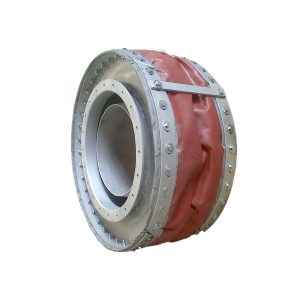
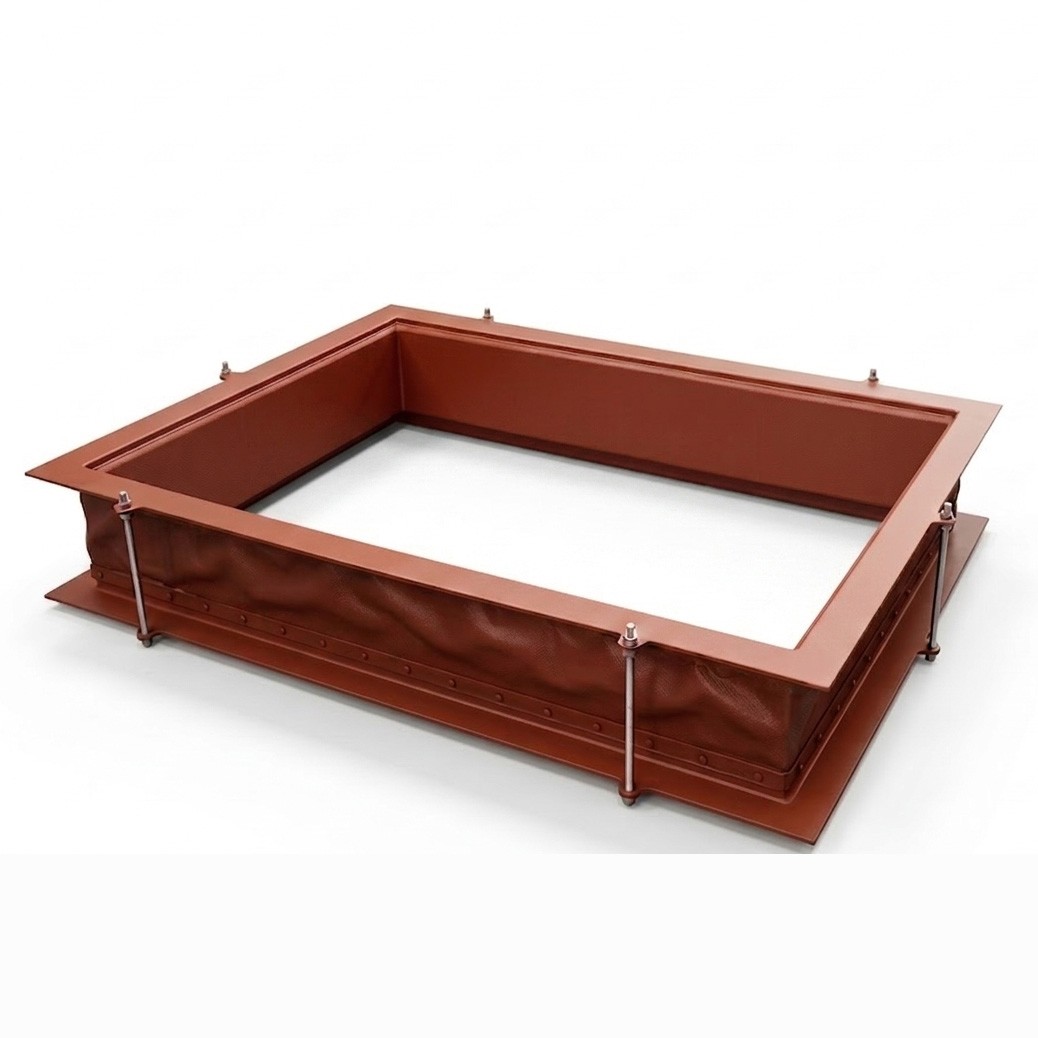
Industrial Rectangular Fabric Expansion Joint (Non-Metallic)
- Multi-layer composite architecture with PTFE chemical barrier membrane and ceramic fiber insulation blanket rated for continuous service up to 1000°C (1832°F).
- Near-zero reaction force transmission to connected ductwork, fan flanges, and support structures — no heavy restraint frameworks required.
- Complete geometry customization: rectangular, square, circular, oval, or fully custom polygonal cross-sections manufactured to your duct drawings.
- FGD/SCR compliant PTFE membrane provides zero gas permeability to acid condensates (H₂SO₄, HCl, HF).
- Delivers effective vibration damping and acoustic noise reduction for ID fans, FD blowers, and rotating industrial equipment — separate vibration isolators are not required.
- Lightweight design (<10% of equivalent metal bellows weight) allows simple installation without heavy lifting cranes.
- Multi-plane movement compensation: axial compression/extension, lateral offset, and angular deflection in all directions within one compact unit.
- Optional inner flow liner made of high-alloy steel foil for applications with erosive high-speed particulate media.
Industrial Rectangular Fabric Expansion Joint (Non-Metallic)
DEVEL Rectangular Fabric Expansion Joint is a state-of-the-art non-metallic flexible connector engineered specifically for high-temperature flue gas and industrial air ducting systems where conventional metallic bellows are impractical due to extreme thermal movement, large duct dimensions, or complex geometric configurations.
Unlike metal expansion joints that have limited stroke per length and transfer significant reaction forces into the supporting structure, our fabric joints utilize an advanced multi-layer composite architecture — combining high-tensile technical fabrics, PTFE chemical barrier membranes, ceramic fiber insulation blankets, and weatherproof silicone outer protection — to deliver virtually unlimited multi-plane flexibility with near-zero stress transmission.
These joints represent the ultimate solution for power plants, steel mills, cement facilities, and heavy industrial processes requiring superior compensation for thermal expansion, vibration isolation, and significant structural misalignment in circular, oval, rectangular, or custom-shaped ducting layouts.
Key Features at a Glance
- Multi-Layer Composite Architecture
Each joint is constructed from up to five distinct functional layers working in concert: (1) Outer Protective Layer of silicone or fluorine-coated fiberglass cloth for UV/weather resistance; (2) Structural Support Ply of high-tensile technical fabrics maintaining shape under pressure; (3) Chemical Barrier Membrane of PTFE (Teflon®) providing zero gas permeability and total acid condensation resistance (FGD/SCR compliant); (4) Thermal Insulation Layer of multi-layer ceramic fiber or needle-felt blankets protecting the outer skin from continuous temperatures up to 1000°C (1832°F); (5) Optional inner liner of high-alloy steel foil for extreme erosion conditions. - Integrated Multi-Plane Movement Compensation
The high-flexibility composite structure simultaneously accommodates large axial compression and extension, lateral offset (shear), and angular deflection in all directions — all within a single compact unit. This multi-axis capability allows the fabric joint to handle complex ducting layouts where installation space is extremely limited and multiple planes of movement must be absorbed simultaneously without requiring additional hardware. - Near-Zero Reaction Force Transmission
Unlike stiff metal bellows that generate substantial spring forces when compressed or deflected, the inherently low spring rate of technical fabric composites ensures that negligible mechanical stress is transferred to connected ductwork, fan flanges, turbine casings, or support structures. This characteristic eliminates the need for costly external restraint frameworks, heavy-duty anchor blocks, and guided sliding supports typically required with metallic expansion joints. - Extreme Temperature Capability — Up to 1000°C
With properly specified insulation layer thickness and material grade, fabric expansion joints withstand continuous operating temperatures up to 1000°C (1832°F) while keeping the outer protective skin within safe touch temperature limits. The multi-layer insulation system uses ceramic fiber blankets rated for continuous service at extreme temperatures, with thickness customized based on internal gas temperature, flow velocity, and ambient conditions at each installation point. - Complete Geometry Customization
Manufactured to any shape required by your duct design: standard rectangular and square profiles, circular (DN20–DN5000), oval/elliptical, or fully custom geometries including L-bends, T-junction offsets, and irregular polygonal cross-sections. Each unit is custom-engineered from your duct drawings with flange drilling patterns, corner radii, and overall dimensions precisely matched to existing equipment interfaces — no “close enough” approximations. - Advanced Chemical & Acid Resistance
The integrated PTFE (Teflon®) chemical barrier membrane provides absolute zero permeability to corrosive gases including sulfuric acid condensate (H₂SO₄), hydrochloric acid (HCl), hydrofluoric acid (HF), and other acidic dew-point species generated in FGD (Flue Gas Desulfurization), SCR (Selective Catalytic Reduction), and waste incineration processes. The PTFE layer remains gas-tight and chemically inert even after thousands of thermal cycling events. - Effective Vibration & Acoustic Damping
The non-metallic elastomer and fabric layers act as a natural damping interface between vibrating rotating equipment (ID fans, FD blowers, induced draft fans, centrifugal compressors) and rigid ductwork structures. This intrinsic damping capability significantly reduces transmission of both low-frequency structural vibration and high-frequency aerodynamic noise from heavy-duty industrial blowers — often eliminating the need for separate vibration isolators or acoustic silencers at the connection point. - Lightweight & Simplified Installation
Fabric joints weigh a fraction of equivalent metal bellows assemblies — typically less than 10% of the weight of a comparable stainless steel rectangular expansion joint. This dramatic weight reduction eliminates corrosion/rust issues entirely, removes the need for heavy crane lifting equipment on site, and enables belt-type segmented delivery for ultra-large ducts that cannot fit through standard access openings. Field splicing kits allow safe on-site assembly without specialized tools.
Construction Layers & Material System
Layer 1 — Outer Protective Skin: Heavy-duty fiberglass cloth impregnated with Silicone rubber or Fluorine (Viton/FKM) elastomer coating. Provides complete weatherproofing against rain, snow, wind-blown particulate, and intense UV solar radiation for outdoor exposed installations. Available in standard gray (silicone) or distinctive colors for safety identification.
Layer 2 — Structural Support Ply: High-tensile technical fabrics woven from premium Polyester, Aramid (Kevlar® type), Glass fiber, or Silicate yarns depending on temperature and strength requirements. This load-bearing ply maintains dimensional stability, resists positive and negative pressure loading, and defines the joint’s overall shape and geometry.
Layer 3 — Chemical Barrier (Critical): Specialized PTFE (Teflon®) expanded membrane ensuring zero gas permeability. This is the most critical layer for FGD/SCR applications — it provides total impermeability to acid condensation products while remaining flexible across the full -40°C to +260°C PTFE service range. Thickness options from 0.08mm to 0.5mm available.
Layer 4 — Thermal Insulation Blanket: Multi-layer ceramic fiber blanket (1260STD / 1400HP / 1600HA grades) or needle-felt insulation with density ranging from 96 kg/m³ to 192 kg/m³. Thickness is calculated based on heat transfer analysis for each specific application — typical installations use 25mm to 100mm of insulation depending on gas temperature differential. Keeps outer surface below 60°C for personnel safety.
Optional Layer 5 — Inner Flow Liner: For applications involving high-velocity abrasive particulate, fly ash entrainment, or erosive gas streams, an optional inner liner of high-alloy stainless steel (310SS, 321SS, Inconel®) foil or wire-reinforced fabric can be installed as a sacrificial wear surface protecting the primary composite structure from direct impingement damage.
Technical Parameters & Specifications
Note: All specifications above follow DEVEL factory engineering standards. Actual dimensions, material combinations, insulation thickness, and pressure ratings are customized according to each project’s specific operating parameters. Contact our engineering team with your duct drawings for a detailed proposal.
Typical Application Scenarios
Power Generation Sector: Gas turbine exhaust ducts (GTG outlet connections experiencing rapid thermal cycles during start-up/shutdown), boiler flue gas ductwork between economizer and air preheater, FGD inlet/outlet absorber towers (acid-resistant configuration), SCR reactor inlet/outlet ducts, HRSG (Heat Recovery Steam Generator) transition ducts, and stack base flexible connections absorbing wind-induced sway movement.
Heavy Industry — Steel & Metals: Sintering plant exhaust gas ducts, blast furnace off-gas cleaning systems, basic oxygen furnace (BOF) fume extraction, electric arc furnace (EAF) baghouse inlet ducting, coke oven gas (COG) collection mains, and continuous casting machine secondary cooling air ducts — all characterized by extreme temperatures combined with aggressive particulate loading and thermal shock cycling.
Cement & Mineral Processing: Cement kiln inlet/preheater tower ducts (the single largest application segment), raw mill outlet ducts, coal mill hot air supply ducts, clinker cooler exhaust air systems, and kiln bypass ducts handling dust-laden gases at 300–450°C with frequent temperature excursions exceeding 500°C during upset conditions.
Waste Management & Chemical Processing: Municipal solid waste (MSW) incinerator boiler convection pass ducts, hazardous medical waste incineration secondary combustion chamber outlets, chemical scrubber inlet/outlet connections (corrosive wet/dry gas environments), refinery FCCU (Fluid Catalytic Cracking Unit) catalyst regeneration flue gas lines, and marine exhaust stack onboard offshore platform installations.
Typical Applications
Boiler Flue Gas Systems
FGD Flue Gas Desulfurization
SCR Denitrification Systems
Cement Kiln Inlet Ducts
Steel Mill Dust Extraction
Smelting Furnace Off-Gas
Waste Incineration Plants
Chemical Scrubber Connections
Fan Inlet / Outlet Flexible Connectors
Hot Air Duct Compensators
Product Tags
Non-Metallic Bellows
Rectangular Flexible Connector
PTFE Chemical Barrier
Ceramic Fiber Insulation
High Temperature Duct
Silicone Coated Fiberglass
Aramid Fabric
Zero Reaction Force
FGD Compliant
Custom Shape
Vibration Isolation
Acoustic Damping
Request a Custom Quote for Your Project
Factory-direct pricing available. DEVEL engineering team ready to assist with material selection, sizing calculations, and installation guidance.