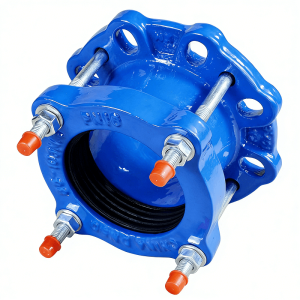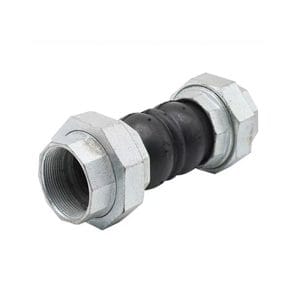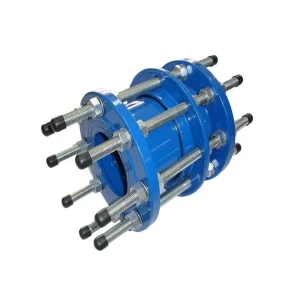
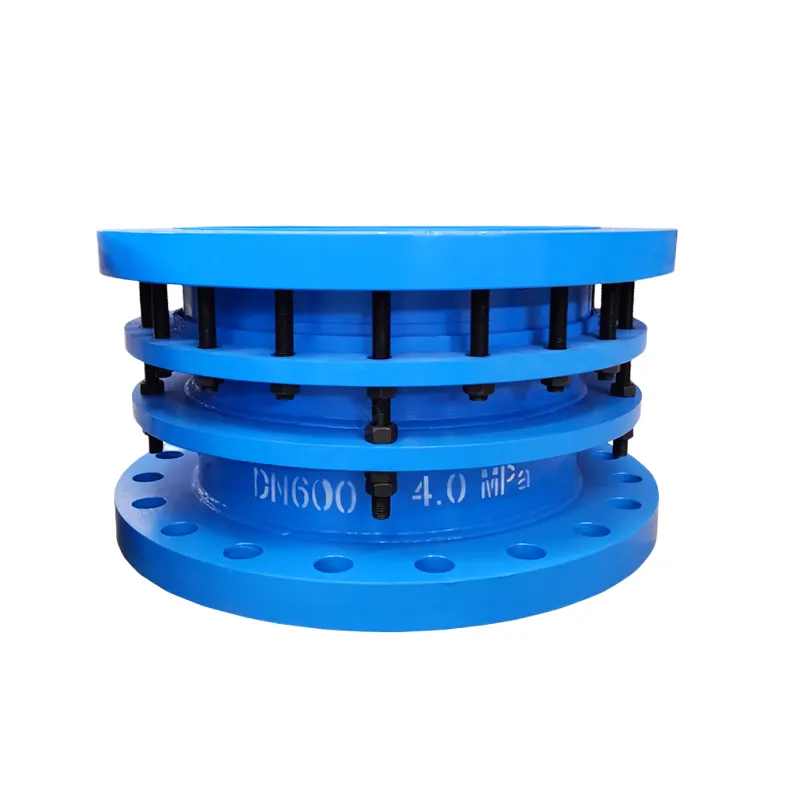
Double Flange Dismantling Joints (B2F type)
DEVEL B2F double flange dismantling joint absorbs axial movement and locks pressure thrust for safe valve/pump maintenance. GB/T 12465-2017, DN65–DN3600.
- Axial travel ±25–90 mm — absorbs thermal expansion and pipe settlement
- Limit rods restrain pressure thrust — protects pump nozzles and valve bodies
- Dismantling gap up to 90 mm — remove valves and meters without pipe cutting
- Multi-material — carbon steel, WCB, ductile iron, 304/316L stainless
- 1.5× strength test, 4× burst test — certified zero leakage
DEVEL Double Flange Dismantling Joints (B2F type) are steel sleeve expansion joints with limit rods, designed to absorb axial displacement and contain pressure thrust in flanged piping systems. Unlike flexible rubber joints that absorb vibration, the B2F is a structural mechanical device: a telescoping sleeve sealed by a gland-packed ring, locked against over-travel by external limit rods. Manufactured to GB/T 12465-2017, available DN65–DN3600 with PN6/PN10 rating, in carbon steel, WCB, ductile iron, 304 and 316L.
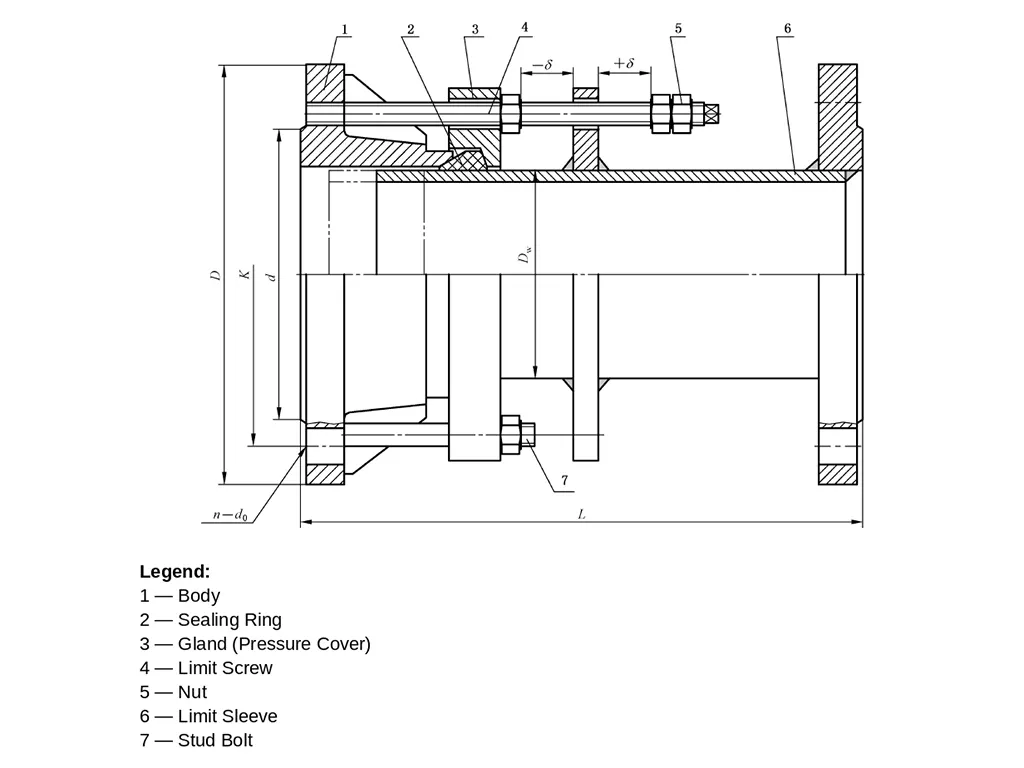
What Is a B2F Dismantling Joint and Why Engineers Specify It
DEVEL Double Flange Dismantling Joints — also referred to as B2F sleeve expansion joints, limit rod expansion joints, or simply dismantling joints — are rigid steel pipe connectors engineered to provide a limited amount of axial movement while simultaneously restraining pressure thrust loads generated by internal pipeline pressure.
Unlike flexible rubber joints that absorb vibration and multi-plane movement, a B2F dismantling joint is a structural mechanical device: it uses a telescoping sleeve (limit expansion pipe) running inside a main body, sealed by a gland-packed compression ring, and locked against over-travel by external limit rods. This architecture allows the joint to extend or retract within a designed range (±δ) for installation, thermal expansion, and dismantling — while the limit rods mechanically transfer pressure thrust to the pipeline anchors instead of loading the adjacent equipment flanges.
As a factory-direct manufacturer of pipe expansion joints and fluid control solutions, DEVEL supplies B2F dismantling joints in full compliance with GB/T 12465-2017, covering DN65 to DN3600 (PN6) and DN65 to DN3000 (PN10). Common applications include municipal water and wastewater treatment, power plant cooling water, desalination, oil terminals, and any flanged piping system where a valve, pump, or removable spool piece must be isolated for maintenance without cutting the pipe.
Key Features of the Double Flange Dismantling Joint (B2F)
- Axial Displacement Compensation with Positive Limit Stops
The telescoping sleeve design provides a defined axial travel of ±δ (typically 25 mm at DN65–DN150, scaling up to 90 mm at DN3000), absorbing thermal expansion, pipe settlement, and installation tolerances. The external limit rods mechanically prevent over-travel — protecting the sealing element from extrusion, the gland from deformation, and the adjacent flanges from overload. - Pressure Thrust Restraint Without Loading the Equipment Flange
In any pressurized piping system, a free-moving expansion joint transmits the full hydraulic end-load (pressure × cross-sectional area) to the nearest anchor. At PN10 and DN600, that load exceeds 280 kN — enough to damage pump nozzles, valve bodies, or thin-wall equipment. The B2F’s limit rods carry this thrust internally, allowing the joint to be installed directly against a valve or pump without requiring independent anchor blocks on both sides. - Dismantling Function for Valve and Equipment Maintenance
By retracting the sleeve to its full compression limit (−δ), the B2F creates a clearance gap of 25–90 mm between the two flanged ends. This allows a technician to remove a valve, flow meter, strainer, or pump without cutting or re-welding the pipeline — a critical maintenance advantage in water treatment plants, district heating networks, and refinery process lines. - Multi-Material Construction for Aggressive and Potable Service
The body, gland, and telescoping sleeve are available in carbon steel (Q235 / 20) for general service, cast steel (WCB) for higher pressure, ductile iron (QT400-15 / QT450-10) for buried water, and stainless steel (304 / 316L) for seawater, chemical, and food-grade applications. Sealing elements are matched to the medium: NBR for oil, EPDM for hot water and steam, PTFE-encapsulated for chemical service. - Certified Pressure Integrity — 1.5× Strength Test and 4× Burst Test
Every B2F joint undergoes a hydrostatic strength test at 1.5 times rated working pressure for 5 minutes (zero leakage, zero plastic deformation). A batch sample is further subjected to a burst test at 4 times rated pressure for 5 minutes. Length tolerances ±5 mm, flange perpendicularity 1% DN (≤4 mm), coaxiality 1% DN (≤5 mm) — in full compliance with GB/T 12465-2017 §5.4–5.6.
Technical Parameters & Material Specifications
| Technical Property | Specification |
|---|---|
| Product Name | Double Flange Sleeve Limited Expansion Joint (B2F) |
| Standard Compliance | GB/T 12465-2017 (Pipe Compensation Joints) |
| Nominal Diameter (DN) | DN65 – DN3600 (PN6) / DN65 – DN3000 (PN10) |
| Working Pressure | PN6 / PN10 |
| Operating Temperature | ≤ 170 °C (continuous) |
| Axial Movement (±δ) | 25 mm (DN65–150) up to 90 mm (DN≥2800) |
| Body / Gland / Sleeve Material | Q235, 20 steel, WCB, QT400-15, QT450-10, 06Cr19Ni10 (304), 022Cr17Ni12Mo2 (316L) |
| Seal Ring Material | NBR, EPDM, Silicone, PTFE-encapsulated (media dependent) |
| Limit Rod / Stud Material | Q235A, 35 steel, 45 steel, 304 / 316L stainless |
| Surface Coating | Hot-dip galvanized (standard), epoxy, plastic coated, nickel plated |
| Flange Drilling | GB, ASME B16.5, DIN, BS EN 1092, JIS — custom available |
| Strength Test | 1.5 × rated pressure, 5 min hold, zero leakage |
| Burst Test | 4 × rated pressure, 5 min hold, zero visible cracking |
| Safety Factor | ≥ 4:1 (burst vs. working pressure) |
Material & Coating Selection Guide
The B2F is a configurable product. Select body material, seal material, and surface coating based on the service medium and installation environment:
Body Material Selection
| Code | Material | Best For | Limitations |
|---|---|---|---|
| G | Carbon steel (Q235) | General industrial water, HVAC, compressed air | Not for buried service without coating |
| ZG | Cast steel WCB | Higher pressure, steam, hot oil | Higher cost; heavier |
| Q | Ductile iron QT400-15 | Buried municipal water, sewage, potable water | Not for high-temperature steam |
| N | 06Cr19Ni10 (304 SS) | Seawater, food, pharmaceutical, mild chemicals | Pitting risk in stagnant chloride service |
| N1 | 022Cr17Ni12Mo2 (316L SS) | Chemical, marine, desalination, high-chloride | Premium cost |
Seal Ring Material Selection
| Seal Material | Temperature Range | Best For | Avoid For |
|---|---|---|---|
| NBR | −15 °C to +100 °C | Oils, fuels, compressed air, water | Ozone, strong oxidizers, UV |
| EPDM | −20 °C to +150 °C | Hot water, steam, cooling water, potable water | Petroleum-based fluids |
| Silicone | −40 °C to +200 °C | High-temperature air, food and pharmaceutical | High pressure, petroleum |
| PTFE-encapsulated | −30 °C to +180 °C | Strong acids, alkalis, solvents, aggressive chemicals | Low-pressure-only; costly |
Surface Coating Selection
| Code | Coating | Typical Application |
|---|---|---|
| Z | Hot-dip galvanized | Standard for above-ground and sheltered outdoor service |
| S | Plastic coated (PE/epoxy) | Buried pipelines, aggressive soil, water and sewage |
| N | Nickel plated | Food, pharmaceutical, decorative / clean-in-place service |
| H | Epoxy coated | Potable water, chemical plants, marine environments |
Not sure which material fits your application? Our engineers can recommend the right body, seal, and coating combination based on your media, temperature, and pressure. Contact us for technical support →
B2F Dimensional Data (PN6)
| DN (mm) | Inch | L (mm) | ±δ (mm) | D (mm) | K (mm) | d (mm) | n–d₀ | Mass (kg) |
|---|---|---|---|---|---|---|---|---|
| 65 | 2.5 | 300 | 25 | 160 | 130 | 110 | 4–M12 | 13.3 |
| 80 | 3 | 310 | 25 | 190 | 150 | 125 | 4–M16 | 17.5 |
| 100 | 4 | 320 | 25 | 210 | 170 | 145 | 4–M16 | 22.5 |
| 125 | 5 | 330 | 25 | 240 | 200 | 175 | 8–M16 | 29.0 |
| 150 | 6 | 340 | 25 | 265 | 225 | 200 | 8–M16 | 36.5 |
| 200 | 8 | 380 | 30 | 320 | 280 | 255 | 8–M16 | 56.0 |
| 250 | 10 | 420 | 30 | 375 | 335 | 310 | 12–M16 | 78.0 |
| 300 | 12 | 450 | 35 | 440 | 395 | 362 | 12–M20 | 105 |
| 350 | 14 | 480 | 35 | 490 | 445 | 412 | 12–M20 | 135 |
| 400 | 16 | 510 | 40 | 540 | 495 | 462 | 16–M20 | 168 |
| 450 | 18 | 540 | 40 | 595 | 550 | 518 | 16–M20 | 205 |
| 500 | 20 | 570 | 40 | 645 | 600 | 568 | 20–M20 | 245 |
| 600 | 24 | 620 | 45 | 755 | 705 | 670 | 20–M24 | 350 |
| 700 | 28 | 670 | 45 | 860 | 810 | 775 | 24–M24 | 460 |
| 800 | 32 | 720 | 50 | 975 | 920 | 880 | 24–M24 | 590 |
| 900 | 36 | 770 | 50 | 1075 | 1020 | 985 | 24–M27 | 740 |
| 1000 | 40 | 820 | 55 | 1175 | 1120 | 1085 | 28–M27 | 910 |
| 1200 | 48 | 920 | 60 | 1375 | 1320 | 1285 | 32–M27 | 1320 |
| 1400 | 56 | 1020 | 65 | 1575 | 1520 | 1485 | 36–M27 | 1820 |
L = face-to-face length at neutral position; ±δ = allowable axial extension/compression; D = flange OD; K = bolt circle; d = sealing face; n–d₀ = bolt count × size. DN1600–DN3600 and PN10 dimensional data available on request. Contact us →
B2F vs. BF vs. BY — Choosing the Right Type
| Type | End Connection | Typical Application |
|---|---|---|
| B2F | Flanged both ends | Pipeline connection to valves, pumps, flanged equipment — most versatile |
| BF | One flange + one weld/bell end | Connection between flanged equipment and steel/PE/ductile iron pipe |
| BY | Bell-and-spigot both ends | Connection between two lengths of ductile iron or PE pipe in buried water networks |
If your project needs a rigid, compact connection that transmits thrust without axial movement, see our C2F Force-Transmitting Dismantling Joint — 30–40% shorter than the B2F, ideal for tight spaces.
Industries and Applications
- Municipal Water & Wastewater: Treatment plant pump stations, raw water intake, clearwell connections, and distribution main isolation points where valves must be removable for service.
- Power Generation: Condenser cooling water, auxiliary cooling loops, and FGD slurry lines — limit rod design restrains the large pressure thrusts generated by high-flow cooling systems.
- Desalination & Marine: Seawater intake and outfall, ballast systems, and ship-to-shore piping — 316L stainless steel construction with EPDM or PTFE seals handles chloride service reliably.
- Oil & Gas Terminals: Tank farm manifolds, pipeline scraper trap connections, and metering skid isolation — WCB or carbon steel with hot-dip galvanized coating for long-term outdoor service.
- District Heating & HVAC: Hot water distribution, boiler feed lines, and heat exchanger connections — EPDM seals handle continuous operation up to 150 °C.
- Industrial Process Piping: Chemical plants, pulp and paper, food and beverage — material combinations available for nearly any neutral or aggressive medium up to 170 °C.
How to Specify a B2F Dismantling Joint — Marking System
GB/T 12465-2017 defines a structured marking system. A complete B2F order code contains all critical parameters:
Example: B2F-6900-G-Z — B2F type, PN6, DN900, carbon steel body (G), hot-dip galvanized (Z).
When requesting a quotation, please provide:
- Nominal diameter (DN) and pressure rating (PN6 or PN10)
- Body material code (G, 20, ZG, Q, Q1, N, N1)
- Seal material (NBR, EPDM, Silicone, PTFE)
- Surface coating (Z, S, N, H)
- Flange drilling standard (GB, ASME, DIN, JIS, BS EN 1092)
- Face-to-face length if non-standard (default per table above)
Installation and Commissioning Notes
- Pipe Preparation: Clean both mating flange faces. Verify flange alignment within the joint’s rated angular tolerance (≤1° offset). The B2F is not designed to correct gross misalignment.
- Neutral Position Installation: Install the joint at its neutral (mid-stroke) position. Do not pre-compress or pre-extend the sleeve during installation.
- Limit Rod Adjustment: After flange bolting, adjust the limit rod nuts to leave a small gap (typically 2–3 mm) between the rod nut and the gland bracket.
- Pressure Test: Hydrostatic test the system at 1.5 × working pressure before commissioning. Inspect gland bolts and limit rod nuts for tightness after the test.
- Dismantling for Maintenance: To remove downstream equipment, loosen the limit rod nuts on one side and compress the sleeve to its −δ limit to create clearance.
Frequently Asked Questions
What is the difference between a dismantling joint and a rubber expansion joint?
A rubber expansion joint uses an elastomeric arch to absorb vibration, noise, and multi-plane movement. A dismantling joint (B2F) is a rigid steel mechanical device with a telescoping sleeve that provides only axial movement within a limited range, while restraining pressure thrust through external limit rods.
Can a B2F dismantling joint replace an anchor block?
Partially. The B2F’s limit rods transfer pressure thrust across the joint itself, eliminating the need for anchor blocks immediately adjacent to the joint. However, the thrust is still transmitted to the pipeline — adequate upstream and downstream anchoring is still required per the project’s piping stress analysis.
What is the maximum temperature for a B2F joint?
The standard B2F is rated for continuous service up to 170 °C with appropriate seal selection (EPDM or PTFE-encapsulated). For higher temperatures, a metallic bellows expansion joint is recommended.
Do you offer B2F joints with ASME or DIN flanges?
Yes. While the body is manufactured to GB/T 12465-2017, the flange drilling can be supplied to ASME B16.5 (Class 150 / 300), DIN, BS EN 1092, or JIS standards to match your existing piping.
How long is the delivery time?
Standard sizes (DN65–DN600, PN6/PN10, carbon steel, hot-dip galvanized) typically ship within 7–10 working days. Larger sizes, stainless steel construction, or custom flange drilling require 3–6 weeks.
Looking for a reliable dismantling joint manufacturer?
Contact DEVEL for factory-direct pricing on B2F double flange dismantling joints, DN65–DN3600, PN6/PN10. Carbon steel, WCB, ductile iron, and stainless steel constructions available. Request Factory Quote →
Tags: Double Flange Dismantling Joint, B2F Expansion Joint, Sleeve Expansion Joint, Limit Rod Joint, GB/T 12465-2017, Dismantling Joint, Pipe Compensation Joint, PN6 / PN10, DN65 – DN3600, Carbon Steel Expansion Joint, Stainless Steel Dismantling Joint, Municipal Water, Power Plant Cooling, Desalination, Valve Isolation Joint