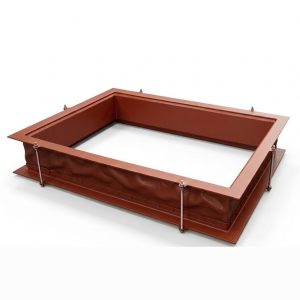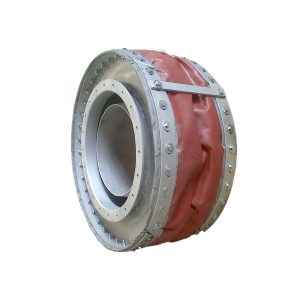

Fabric Belt for Non-Metallic Expansion Joints
1. 7-layer composite fabric belt: fluororubber, SS wire mesh, PTFE diaphragms, fiberglass cloth — engineered for aggressive duct environments.
2. Two material families: silicone-coated fiberglass (up to 600°C) and fluoroelastomer (up to 1000°C) for any operating envelope.
3. Multi-directional movement absorption: axial ±50–300 mm, lateral ±30–150 mm, angular 30–40% of effective length.
4. Integrated insulation bolster (thermal pillow) protects belt core from extreme heat, high-velocity erosion, and acoustic noise.
5. Zero-permeation PTFE dual-diaphragm barrier against sulfuric acid, HCl, HF condensate — FGD and SCR compliant.
6. Engineered back-up bar clamping system with star-pattern torque sequence for uniform sealing pressure without hot-spots.
7. Tensile strength ≥2000 N/50mm with 3–5 year service life; silicone variants offer up to 10-year outdoor weather durability.
8. Covers DN100–DN5000 circular, rectangular custom, and irregular profiles — belt-type segmented delivery for access-limited sites.
Fabric Belt for Non-Metallic Expansion Joints
DEVEL Fabric Belt is a multi-layer flexible sealing component engineered using advanced Fluoroelastomer or Fluoroplastic materials with internal reinforcement from high-strength technical fabric or metallic wire mesh. Designed as the core flexible element within non-metallic expansion joint systems, these fabric belts handle high-concentration condensed fluids and aggressive chemical media, delivering exceptional density, structural integrity, and maximum resistance against chemical permeation.
Available in two primary material families — Silicone-Coated Fiberglass Belts for continuous temperatures up to 230°C (up to 600°C with insulation layers) and Fluoroelastomer Belts for extreme environments up to 1000°C — the product addresses a comprehensive spectrum of industrial duct sealing challenges. Each belt is custom-engineered from your duct drawings with flange drilling patterns, corner radii, and overall dimensions precisely matched to existing equipment interfaces.
Unlike conventional loose-fabric compensators, the DEVEL belt type features a fully engineered system: precision back-up bars with uniform torque distribution, flange-area reinforcement layers, structured steel frames with optional internal flow baffles, and an internal insulation bolster that acts as a thermal “pillow” protecting the flexible core from extreme temperatures and high-velocity turbulent erosion while simultaneously dampening acoustic noise.
Fabrication covers circular sizes from DN100 to DN5000, rectangular custom cross-sections, and fully irregular geometric profiles. With operating temperatures up to 1000°C, working pressures up to 0.5 MPa, axial compensation from ±50 mm to ±300 mm, lateral compensation from ±30 mm to ±150 mm, and tensile strength exceeding 2000 N per 50 mm strip width, this product represents the most robust solution for power plant FGD systems, metallurgical sintering lines, cement kiln inlet/outlet seals, petrochemical incineration flares, and waste-to-energy exhaust cleaning applications.
Key Features at a Glance
- 7-Layer Composite Architecture
Each belt is constructed from seven distinct functional layers working in concert: fluororubber outer skin with stainless steel wire mesh, composite alkali-free cloth, dual PTFE diaphragms, wire-reinforced fiber cloth, fiberglass cloth, and an inner fluororubber gas-seal layer. This multi-ply architecture provides a progressive defense against temperature, chemical attack, gas permeation, and mechanical stress — all within a single compact profile of 8–20 mm total thickness. - Extreme Temperature Capability — Up to 1000°C
With properly specified fluoroelastomer composite layers and integrated ceramic fiber insulation bolsters, fabric expansion joints withstand continuous operating temperatures up to 1000°C while maintaining safe outer-skin temperature limits. Two material families are available: silicone-coated fiberglass for moderate temperatures (up to 600°C with insulation) featuring 10-year outdoor weather resistance, and fluoroelastomer for extreme environments with internal media temperatures reaching 1000°C. - Integrated Multi-Plane Movement Compensation
The high-flexibility composite structure simultaneously accommodates large axial compression/extension (±50–300 mm), lateral offset (±30–150 mm), and angular deflection in all directions — all within a single compact unit. This multi-axis capability absorbs three-dimensional displacements up to 30–40% of the belt’s effective length, making it ideal for complex ducting layouts where multiple planes of movement occur simultaneously without requiring additional hardware. - Superior Chemical Resistance & Zero-Permeation Barrier
The integrated PTFE (Teflon®) dual-diaphragm barrier provides absolute zero permeability to corrosive gases — including sulfuric acid condensate (H₂SO₄), hydrochloric acid (HCl), and hydrofluoric acid (HF) generated in FGD wet scrubber and acid dew-point processes. Combined with the outer fluororubber layer offering excellent acid, alkali, and oil resistance, the belt remains chemically inert and gas-tight through thousands of thermal cycling events. - Engineered Back-Up Bar Clamping System
The flexible belt is securely clamped to the duct steel frame using rigid back-up bars with precisely specified width, thickness, and drill-hole pitch — all tailored to each specific joint type and operating conditions. High-grade bolts with heavy-duty nuts and washers achieve uniform clamping force across the full sealing perimeter via star-pattern torque sequence, eliminating hot-spots and preventing edge-tearing at the clamp interface. - Internal Insulation Bolster — Thermal Pillow Protection
Serves as a technical “pillow” packed with premium insulating material that shields the outer flexible belt against extreme temperatures and mechanical damage from high-velocity, particulate-laden turbulent media. This integrated bolster significantly reduces acoustic noise transmission and protects the gas-seal membrane from direct impingement by fly ash, catalyst particles, and abrasive dust commonly found in flue gas and metallurgical exhaust ducts. - Dual Material Options — Optimized for Your Operating Envelope
Choose between two proven formulations: Silicone-Coated Fiberglass Belt — cost-effective option for low-to-moderate temperature duty (−70°C to 230°C continuous, up to 600°C with insulation), featuring 10-year outdoor weather life, high dielectric strength (20–50 KV/mm), and excellent flexibility. Fluoroelastomer Belt — premium option for extreme thermal and chemical environments (media temperature up to 1000°C, outer skin ≤250°C continuous / 350°C short-term), with superior resistance to aggressive chemical species and positive-pressure systems up to 40000 Pa. - Lightweight & Simplified Installation
Fabric belts weigh a fraction of equivalent metal bellows assemblies — typically less than 10% of a comparable stainless steel expansion joint. This dramatic weight reduction eliminates corrosion/rust concerns entirely, removes the need for heavy crane lifting equipment on site, and enables belt-type segmented delivery for ultra-large ducts that cannot fit through standard access openings. The bolted construction allows quick field replacement without welding, significantly reducing maintenance downtime.
Key Technical Advantages
7-Layer Progressive Defense Architecture
The DEVEL fabric belt employs a meticulously engineered 7-layer stack-up that creates a progressive defense against thermal, chemical, and mechanical attack. Starting from the process side, each layer serves a dedicated function — from the inner fluororubber gas-seal membrane and PTFE chemical barrier, through structural fiberglass and wire-reinforced cloth plies for tensile strength, to the outer fluororubber + 304 stainless steel wire mesh skin for durability. This vertical integration of protective functions means that no single point of failure can compromise system integrity.
Complete 7-Layer Material Specification
| Layer | Material | Thickness |
|---|---|---|
| 1st | 24-Mesh 304 Stainless Steel Wire Mesh + Fluororubber | S = 3.0 mm |
| 2nd | Composite Alkali-Free Cloth | S = 1.0 mm |
| 3rd | PTFE Diaphragm (Chemical Barrier) | S = 0.3 mm |
| 4th | Wire-Reinforced Fiber Cloth (Embedded with 24-Mesh 304 SS Wire) | S = 1.5 mm |
| 5th | Fiberglass Cloth (Structural Ply) | S = 1.5 mm |
| 6th | PTFE Diaphragm (Secondary Barrier) | S = 0.3 mm |
| 7th | Fluororubber (Inner Gas-Seal Membrane) | S = 1.5 mm |
Total thickness: approximately 9.1 mm for the standard 7-layer configuration. Thicker variants (up to 20 mm) are available with additional insulation plies and ceramic fiber blankets for extreme temperature applications. All layer specifications are customizable to match project-specific thermal, chemical, and mechanical requirements.
Silicone vs. Fluoroelastomer — Material Selection Guide
Silicone-Coated Fiberglass Belt: Ideal for moderate-temperature duct systems where cost-effectiveness and long outdoor service life are priorities. Operating range −70°C to +230°C continuous (up to 600°C with thermal insulation layer). Features 10-year weather resistance in outdoor installations, high dielectric strength (20–50 KV/mm), low dielectric constant (3–3.2), and excellent flexibility with high surface friction for secure clamping. Available in single-sided (cost-optimized for one-directional chemical exposure) and double-sided coating configurations. Two curing types available: room-temperature cure for general service and high-temperature cure for superior burnout characteristics (smoke-free, odor-free, rapid self-extinguishing with white ash residue).
Fluoroelastomer Belt: Premium solution for the most demanding thermal and chemical environments. Internal media temperature capability up to 1000°C with properly specified insulation layers. Outer belt skin operates at ≤250°C continuously (350°C short-term peak) with post-installation surface temperature ≤50°C when thermal insulation bolster is deployed. Handles positive system pressures up to 40000 Pa. Designed specifically for FGD desulfurization systems, high-corrosion environments, and coal-fired flue gas pipelines where simultaneous exposure to heat, acid condensate, and abrasive particulates demands the highest-grade protective materials.
Erosion Protection & Acoustic Damping
The internal insulation bolster and optional flow baffles protect the fabric surface from direct impingement by fly ash, catalyst particles, and high-velocity turbulent streams — dramatically extending service life in dusty ducts. The non-metallic composite layers act as a natural damping interface between vibrating equipment (ID fans, FD blowers, centrifugal compressors) and rigid ductwork structures, significantly reducing transmission of both low-frequency structural vibration and high-frequency aerodynamic noise. The result: 3–5 years of dependable service in typical industrial environments, with up to 10-year outdoor durability for silicone variants in less aggressive conditions.
Technical Specifications
| No. | Parameter Item | Specification / Value |
|---|---|---|
| 1 | Max. Operating Temperature | Up to 1000 °C (fluoroelastomer variant with insulation bolster) |
| 2 | Working Pressure | ≤ 0.5 MPa (low-pressure gas / flue duct applications) |
| 3 | Applicable Media | Hot air, flue gas, corrosive gas, dust-laden air, condensate fluids |
| 4 | Axial Compensation | ± 50 mm to ± 300 mm (customizable per project requirement) |
| 5 | Lateral Compensation | ± 30 mm to ± 150 mm |
| 6 | Product Thickness | 8 mm – 20 mm (depending on number of composite layers) |
| 7 | Standard Flange Size | DN100 – DN5000 (circular) / Rectangular & custom cross-sections available |
| 8 | Chemical Resistance | Excellent (acid, alkali, and oil resistance) |
| 9 | Tensile Strength | ≥ 2000 N / 50 mm (strip test) |
| 10 | Service Life | 3 – 5 years (varies by working environment and duty cycle) |
| — | Design Standards | ASME B31.1, ISO 15547, EJMA guidelines for non-metallic expansion joints |
System Construction & Components
Single or multi-layered technical plies containing an engineered gas-seal membrane (chemical/permeability barrier), high-density thermal insulation blanket, and robust reinforcing members for structural integrity under combined loads.
An additional targeted reinforcement layer integrated into the flange clamping zone isolates and protects the core flexible elements from direct contact with rigid steel parts, preventing stress concentration and edge-tearing at the clamp interface.
The flexible belt is clamped to the duct steel frame using rigid back-up bars. Bar specifications — width, distance between drill-holes, and thickness — are precisely determined based on the expansion joint type and specific operating conditions.
Optimum uniform clamping force is achieved using high-grade bolts along with heavy-duty nuts and washers. Star-pattern torque sequence ensures even compression across the full sealing perimeter without over-stressing localized zones.
The ductwork steel frame acts as a rugged flanged support structure. Design can vary based on a wide range of geometries (round, oval, rectangular, or irregular). Internal sleeves or baffles may be incorporated for mechanical protection of the flexible element and insulation bolster.
Serves as a technical “pillow” filled with insulating material. Safeguards the flexible element against high temperatures and mechanical damage from turbulent flows containing high solid particle concentrations and/or high velocities. Additionally provides significant noise reduction.
Alternative Belt Configuration — Class I Layup
For applications where the 7-layer fluoroelastomer configuration exceeds budget or where moderate temperatures and lower chemical aggression are expected, DEVEL offers a cost-optimized 6-layer Class I belt layup:
| Layer | Material | Function |
|---|---|---|
| 1st | Silicone Rubber Glass Fiber Fabric | Outer weatherproof & UV-resistant skin |
| 2nd | Wire-Reinforced Glass Fiber Cloth | Structural tensile reinforcement |
| 3rd | Asbestos Curtain Cloth | Fire-resistant thermal barrier |
| 4th | Polyethylene Film | Moisture / vapor barrier |
| 5th | Asbestos Felt Blanket | Bulk thermal insulation core |
| 6th | Stainless Steel Wire Mesh | Inner mechanical armor / erosion shield |
Installation Guidelines
Surface Preparation: Clean all mating surfaces thoroughly. Remove rust, scale, old gasket residue, and debris from both the duct flange face and the back-up bar contact area. Ensure surfaces are flat within tolerance before proceeding.
Belt Positioning: Center the fabric belt evenly on both sides of the opening. Ensure the insulation bolster is properly seated inside the cavity without folds or bunches. Verify that the gas-seal membrane (fluororubber or PTFE side) faces the process media direction.
Back-Up Bar Alignment: Place back-up bars on both sides of the belt, aligning drill holes precisely with flange bolt holes. Bars should extend uniformly beyond the fabric edge on all sides. Verify that bar width, thickness, and pitch match the project specifications.
Tightening Sequence: Insert bolts through the assembly (flange–bar–belt–bar–flange). Tighten in a star-pattern sequence (opposite quadrants first) to the specified torque value. Do not over-tighten — compress only until a slight convex bulge remains visible in the belt body, indicating proper gasket compression without crushing.
Post-Installation Check: Conduct visual inspection for uniform gap closure around the entire perimeter. Perform a low-pressure leak test before commissioning. Record final torque values and take photographs for maintenance reference files.
Typical Applications
Power Generation
Flue Gas Desulfurization (FGD) systems. Boiler exhaust ducts and chimneys. Gas turbine intake and exhaust ducts. Cooling tower bypass and heat recovery ducts.
Metallurgy & Steel
Blast furnace gas piping and hot-blast ducts. Sintering plant dust extraction systems. Coke oven gas and by-product piping. Electric arc furnace exhaust systems. Basic oxygen furnace off-gas ducts.
Cement & Building Materials
Rotary kiln inlet and outlet seals. Clinker cooler connection ducts and preheater towers. Raw mill and coal mill duct connections. Baghouse and electrostatic precipitator inlet/outlet transitions.
Petrochemical & Chemical
Corrosive gas transport lines and vent headers. Incineration facilities and thermal oxidizers. Flare system knock-out drum transitions. Sulfuric acid regeneration plants. Chlorine and HCl handling ductwork.
Environmental Protection
Waste-to-energy plant exhaust cleaning and stack connections. Industrial air filtration and ventilation systems. Hazardous waste incinerator ducting. Landfill gas collection and flaring systems.
Product Tags
Non-Metallic Fabric Belt
7-Layer Composite Belt
Fluoroelastomer Expansion Belt
Silicone Fabric Compensator Belt
PTFE Chemical Barrier Belt
High-Temperature Fabric Connector
Back-Up Bar Clamping System
Insulation Bolster Joint
FGD Flexible Belt Seal
Flue Gas Duct Flex Belt
Kiln Inlet Seal Belt
Ceramic Fiber Insulated Belt
Corrosive Gas Duct Joint
Request a Custom Quote for Your Project
Factory-direct pricing available. DEVEL engineering team ready to assist with material selection, sizing calculations, and installation guidance for your specific duct system.